Learn to Play
It takes about five minutes to learn.

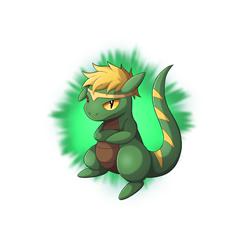
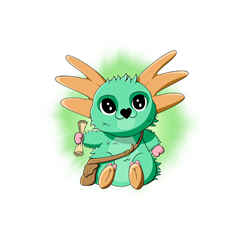
Hi, I'm Nilgie. Let me show you.
Geopals is about exploring, not fighting. You race across a map built from terrain cards, and you will need to think ahead to win.
The five steps below teach you the whole game.
Play it free on a computer, no cards neededHow
The whole game is built in Tabletop Simulator, with every card in the set laid out ready to build a deck from. It is the easiest way to try Geopals properly before you buy anything.
Tabletop Simulator is a paid app on Steam, about A$30. It is not made by us, and the game file below is free.
- Download the Geopals game file.
- Put it in
Documents\My Games\Tabletop Simulator\Saves. - Open Tabletop Simulator and choose Games, then Save & Load.
- Load Geopals. The cards take a moment to appear the first time while the artwork downloads.
Every card is a single copy on the table. Pick the ones you want, copy them, and build a deck. Then read Setting up and play.
You can watch the whole game explained instead. Watch on YouTube
Step 1 of 5
Know your cards
Your deck can contain six types of card. Terrain cards are a seventh type, but they are kept separately and are used to build the map.
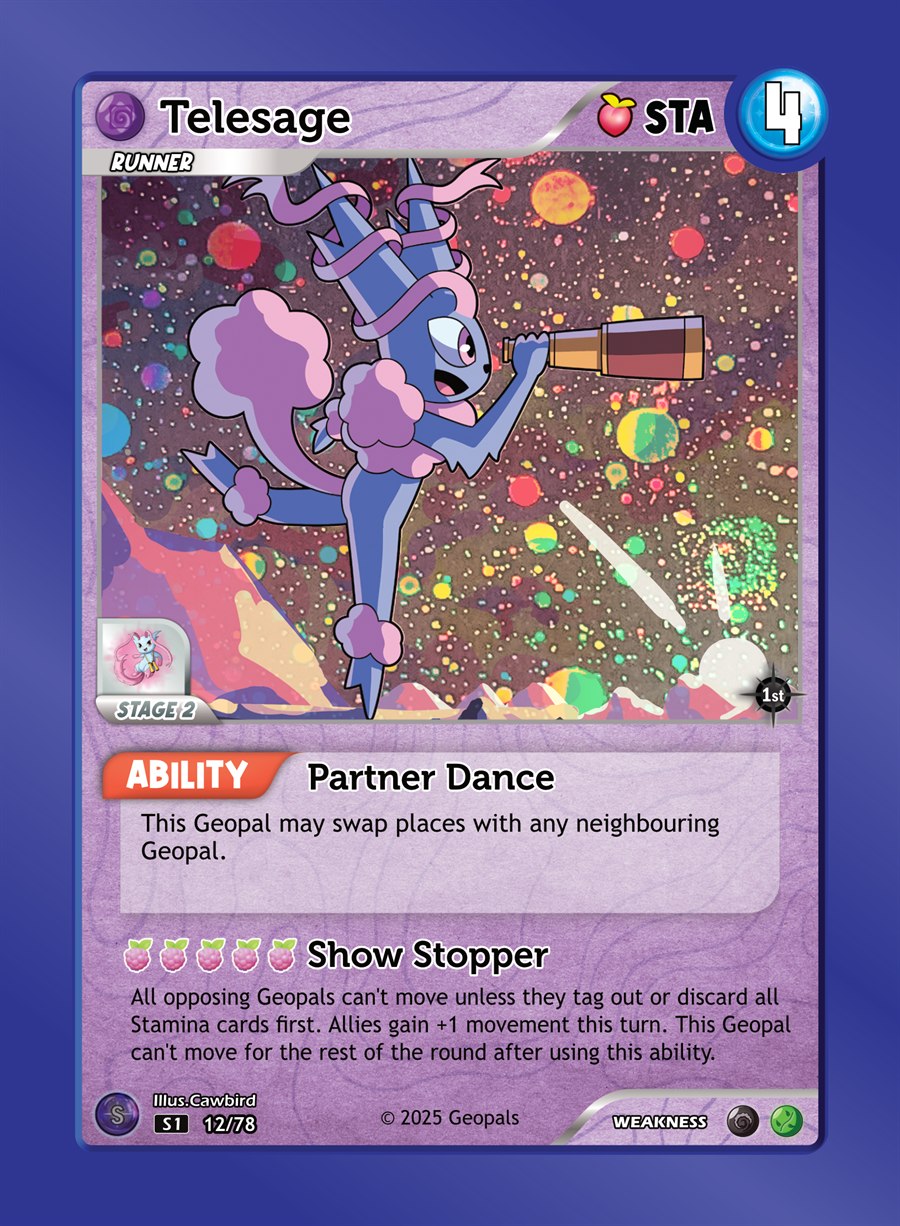
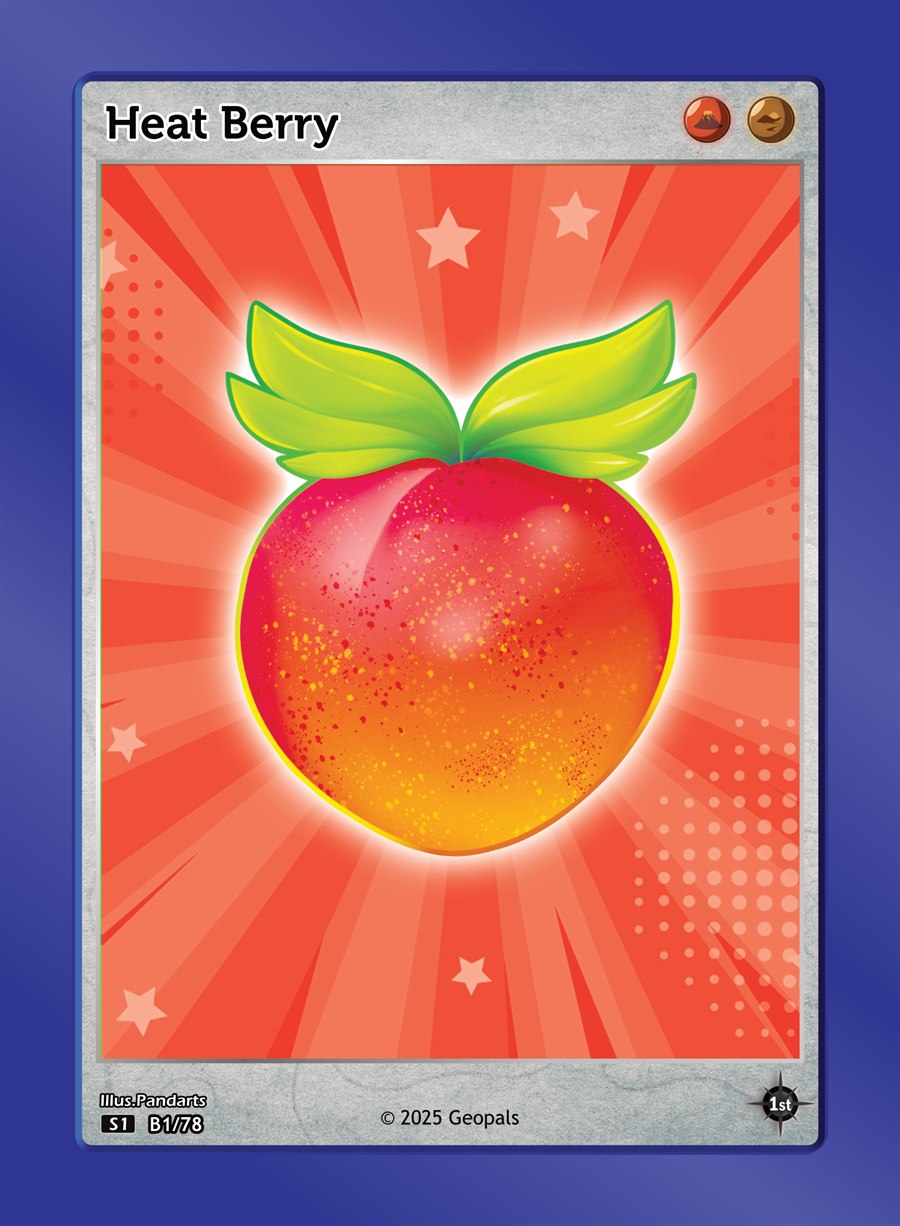
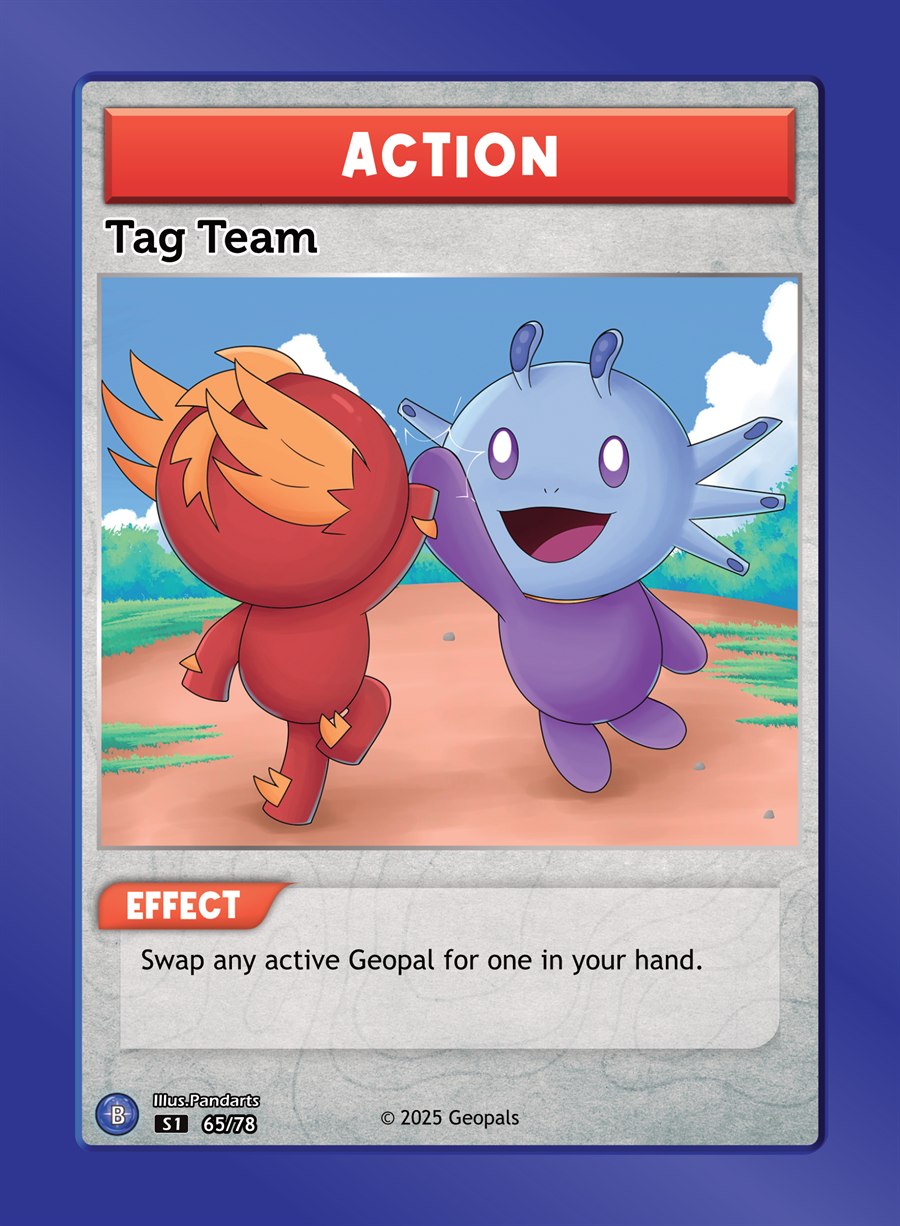
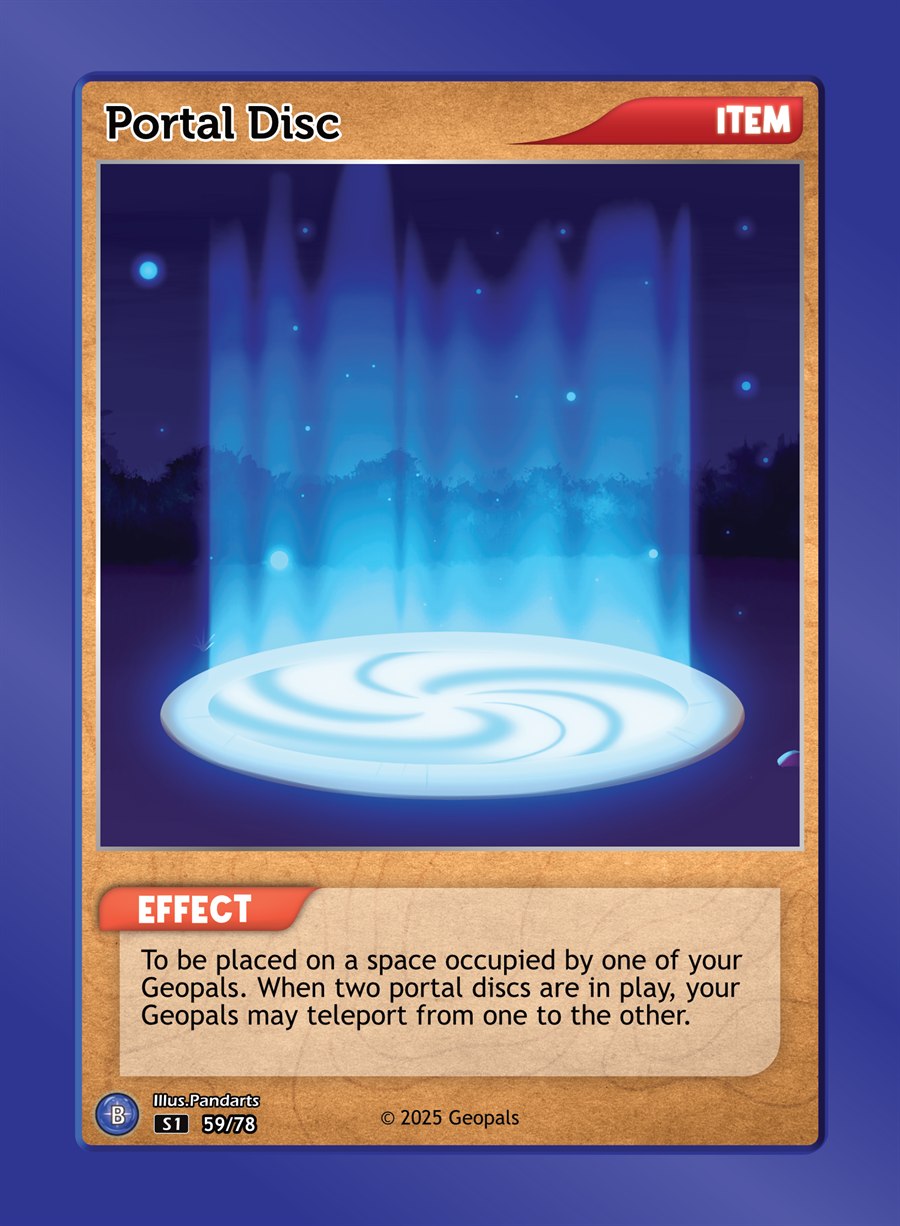
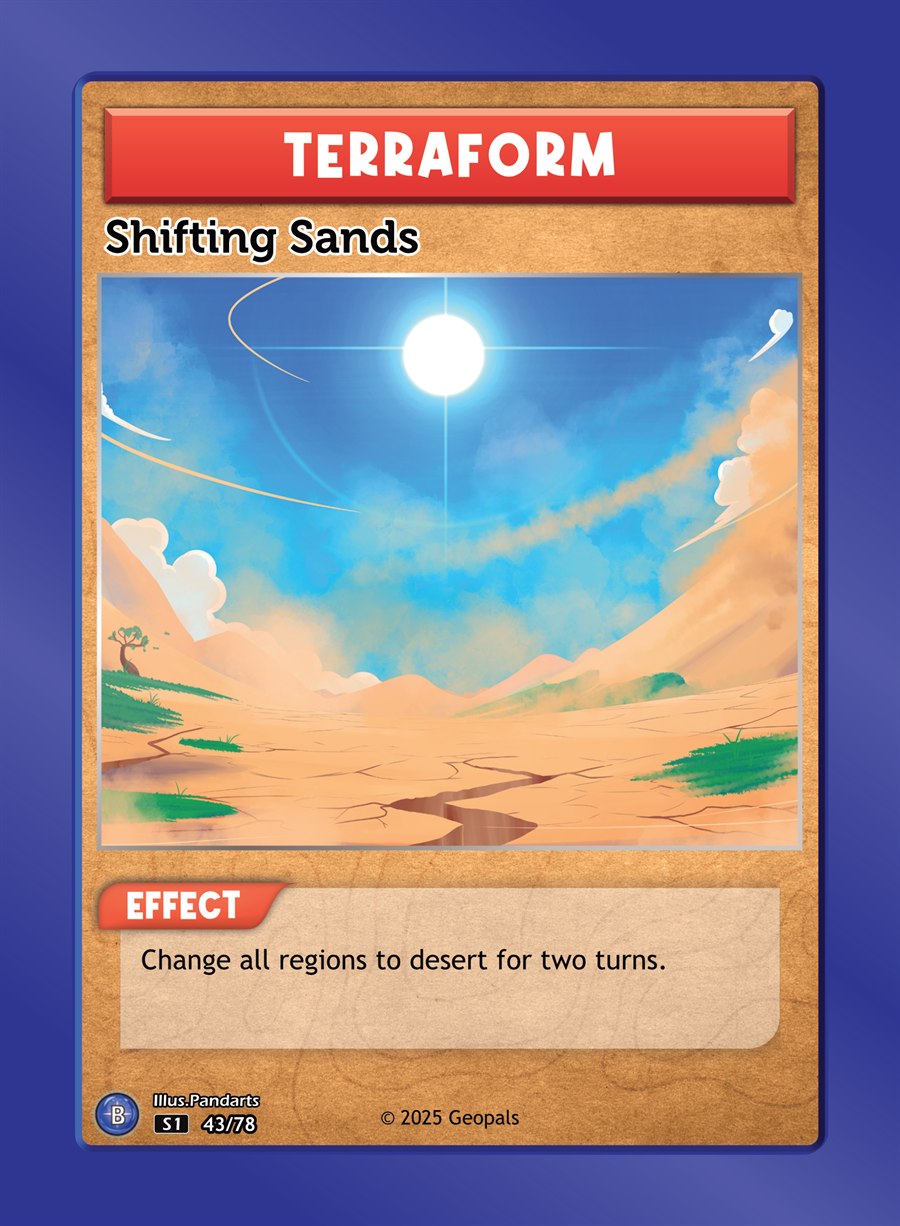
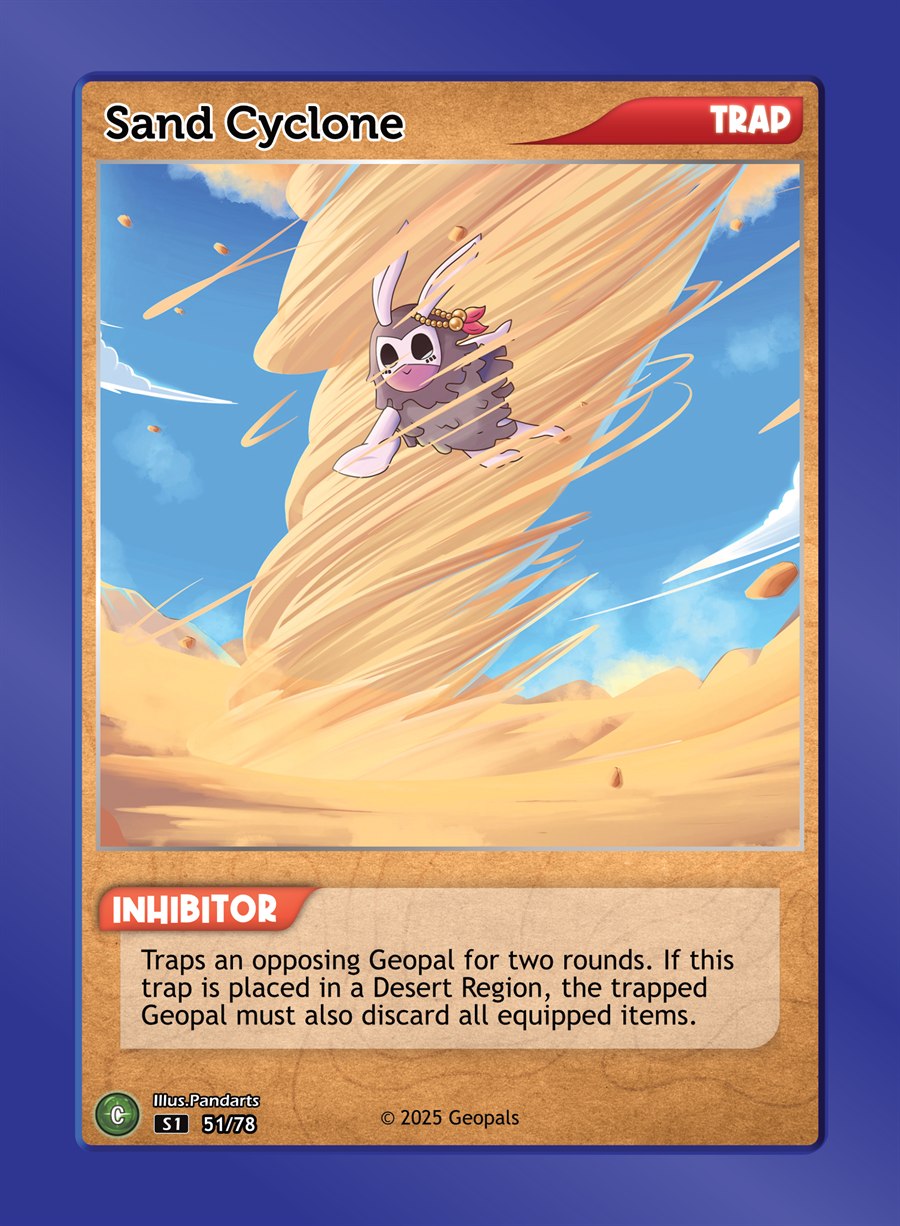
What does each type of card do?
- Geopal. Geopal cards are the characters you race with. Each one has its own abilities. You can have up to three Geopals in play at a time.
- Stamina. Play Stamina cards onto your Geopals to help them move further. A Geopal can hold any number of Stamina cards.
- Action. Action cards create an immediate effect for you or for your opponent. Follow the instructions on the card, then discard it.
- Item. Equip Item cards to your Geopals to give them an ongoing effect. Each Geopal can have only one Item equipped at a time. To take an Item off, you have to discard it, unless an Action card or a Geopal ability lets you remove it another way.
- Terraform. Terraform cards turn every Terrain card on the map into one region for two turns. Two turns means one of your turns and one of your opponent’s, not two of yours. If another Terraform card is played during that time, it replaces the first one.
- Trap. Put Trap cards face down in your Trap Zone and choose a tile for each one. Point out the tile so your opponent knows where it is. You can set one Trap at a time per Terrain card, and never on a tile a Geopal is already standing on. Once a Trap is down you cannot pick it up or replace it. It stays until it goes off.
How to read a Geopal card
Every Geopal card is laid out in the same way.
1
2
3
4
5
6
7
- Region The region this Geopal belongs to. There are eight regions, and this one decides where the Geopal moves well.
- Max Stamina The most tiles this Geopal can ever move in one movement phase. It is not how far the Geopal moves today. That depends on how many Stamina cards you have attached to it.
- Class Runner, Supporter, All Rounder or Chaser. The class tells you what that Geopal is for.
- Stage How far this Geopal has awakened, and what it grew from.
- Passive ability This ability is always available and costs nothing to use.
- Active ability This ability costs Stamina cards, and the berries printed next to it show how many. You spend them. They come off the Geopal and go to your discard pile.
- Weakness The regions this Geopal cannot move through.
Terrain cards and tiles
Terrain cards are not part of your playing deck. You keep them in a separate deck, and you use them to build the map. Each Terrain card is a stretch of one region.
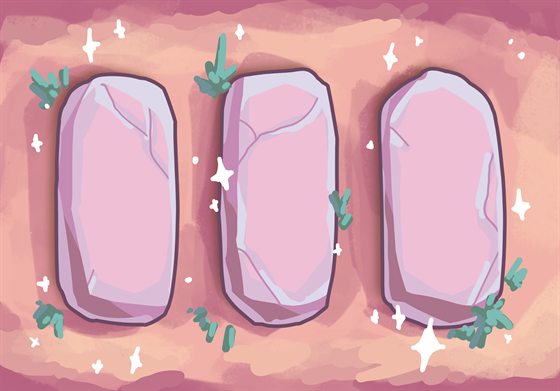
Every Terrain card has a set number of tiles printed on it, between three and five. A tile is one space. Movement is counted in tiles.
Each Terrain card also shows which regions are weak against it. You will find that in the top right corner of the card.
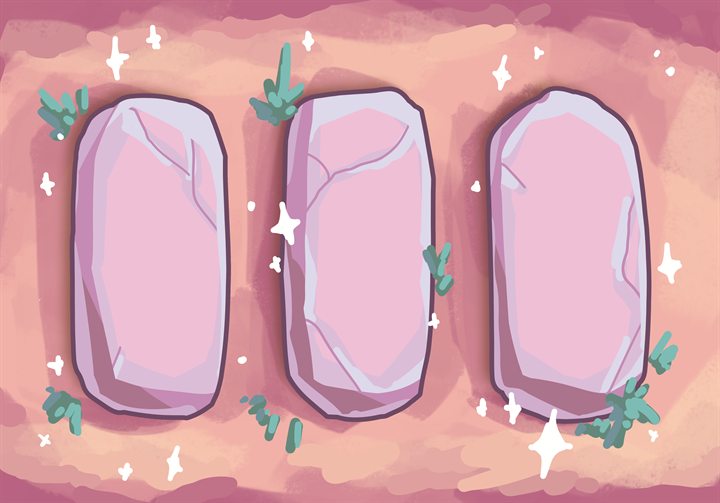
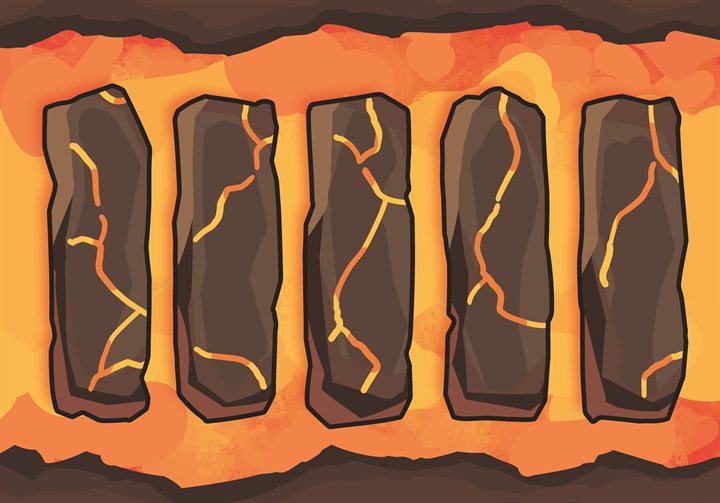
Each player lays two Terrain cards, so the map is always four Terrain cards long. That is a fixed rule.
Which Terrain cards should I bring?
Choosing which Terrain cards to bring
Your Terrain deck is part of your strategy. Choose cards with lots of tiles for regions your Geopals are strong in, because a long stretch of your own ground is a fast run.
Choose cards with fewer tiles for regions your Geopals are weak in, so the ground you cannot cross is as short as possible.
Remember that your opponent is choosing their two cards as well, and they are thinking the same way.
Step 2 of 5
Set up the race
How the table looks
This is a game already under way. The steps further down show you how to lay it out.
See the whole table laid out Both playmats, the map, and every card in its place. Open


 !
Trap set here
Your tokens sit toward your side of each Terrain card, and your opponent’s toward theirs, so you can tell them apart at a glance.
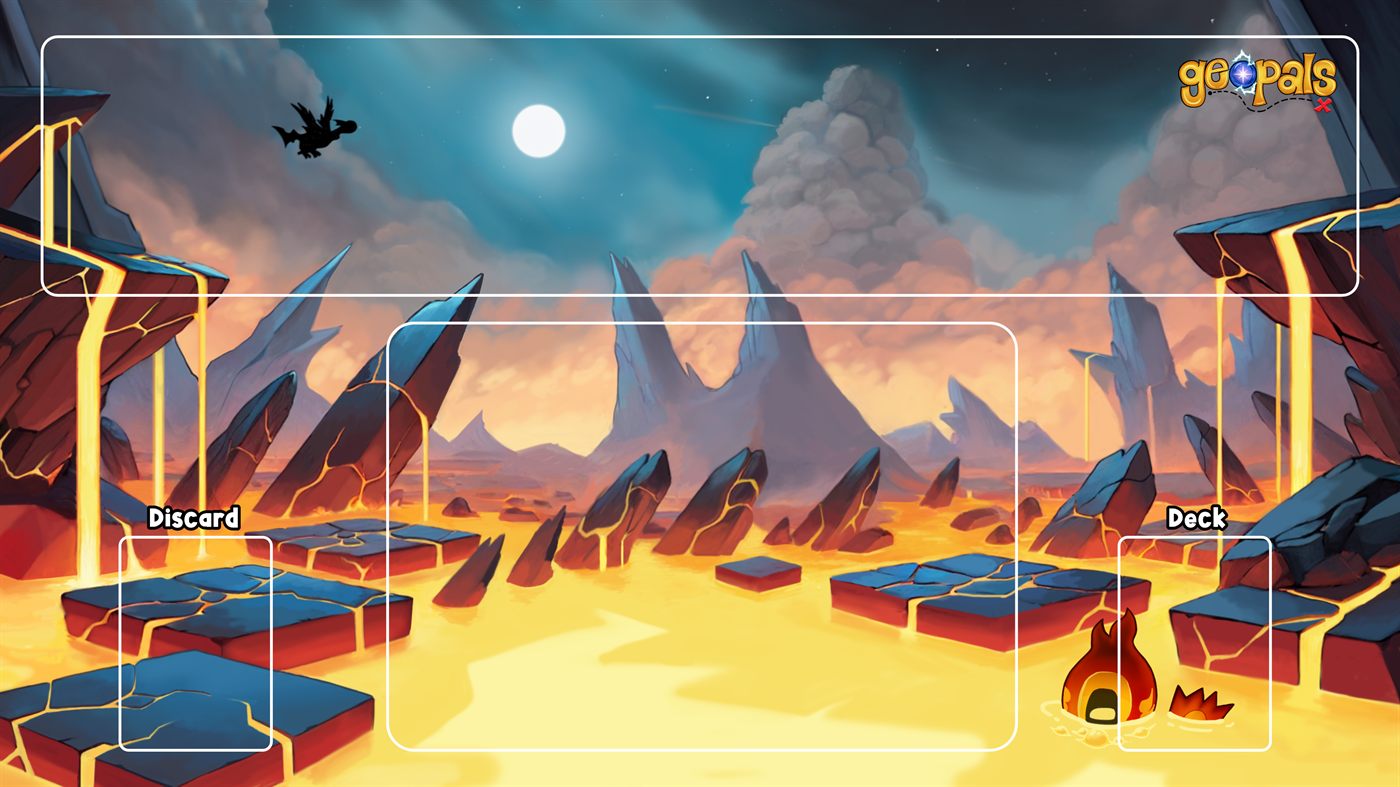
Your mat Everything you control sits here.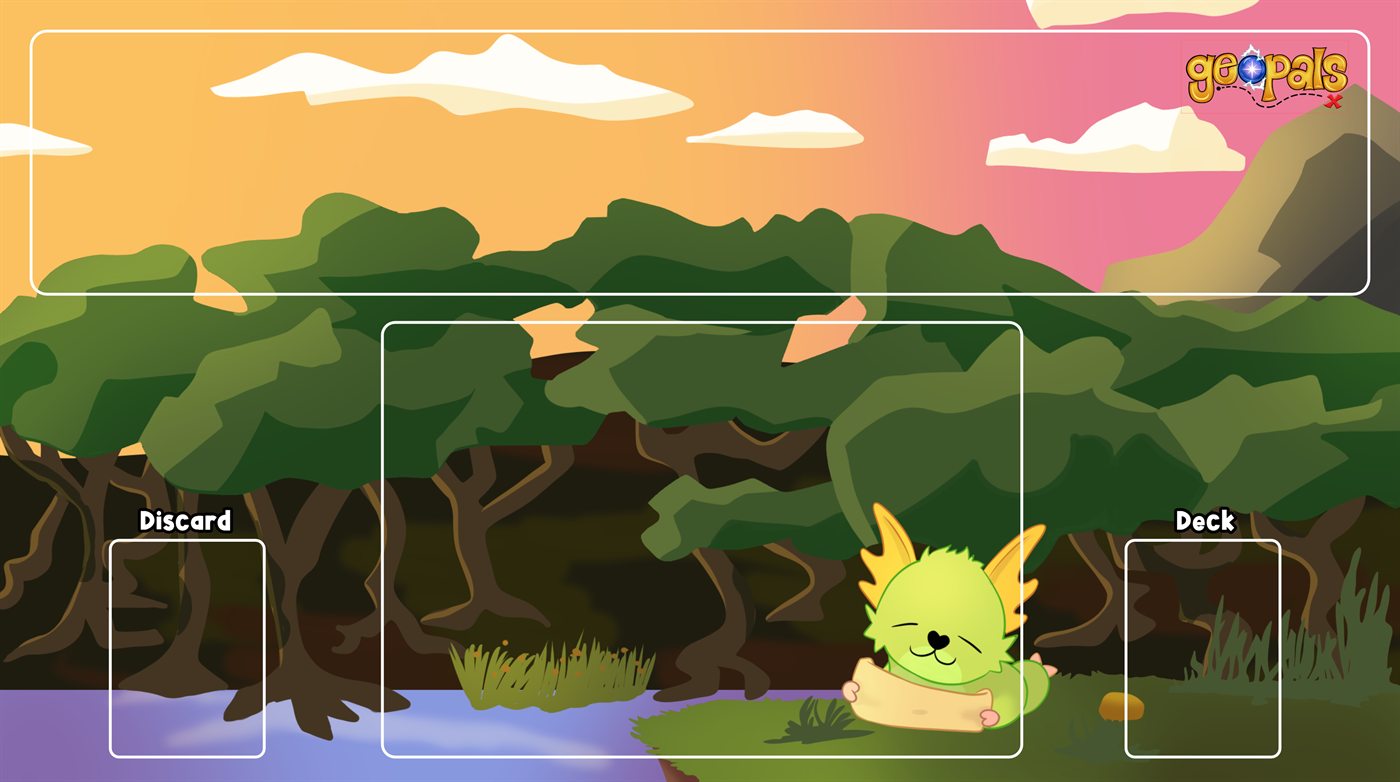 Set on the tile above
Trap Zone

 Play Zone
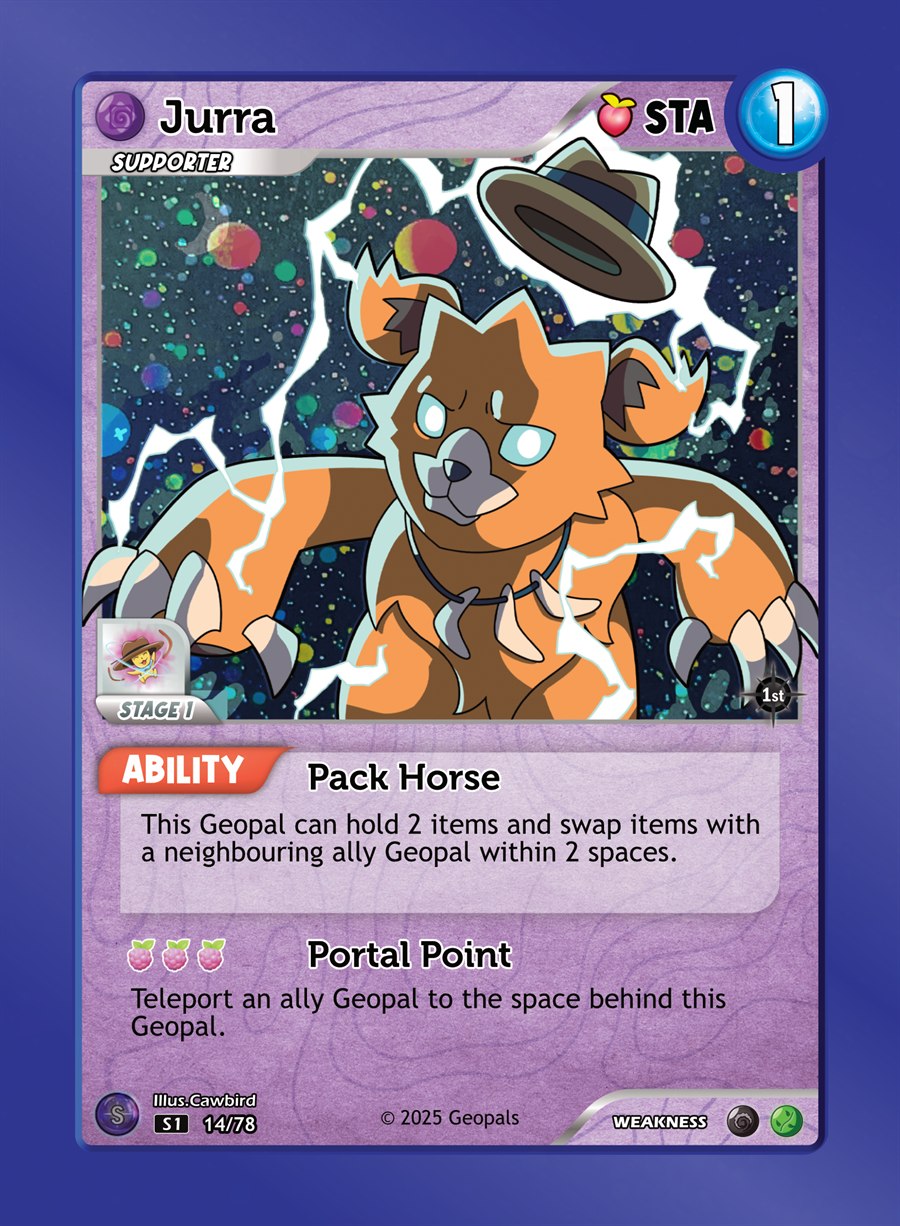
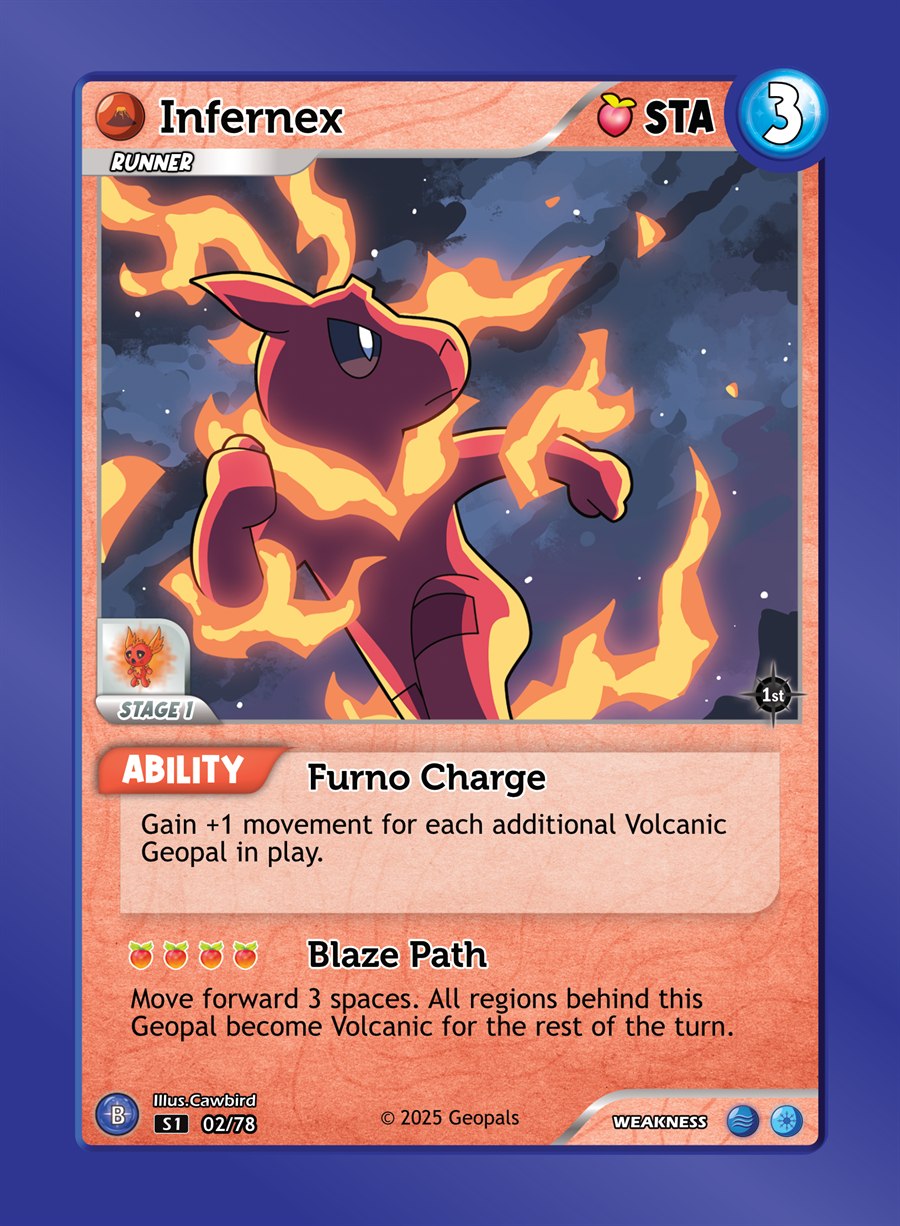 Awakened forms
Scroll the board sideways to see all of it.
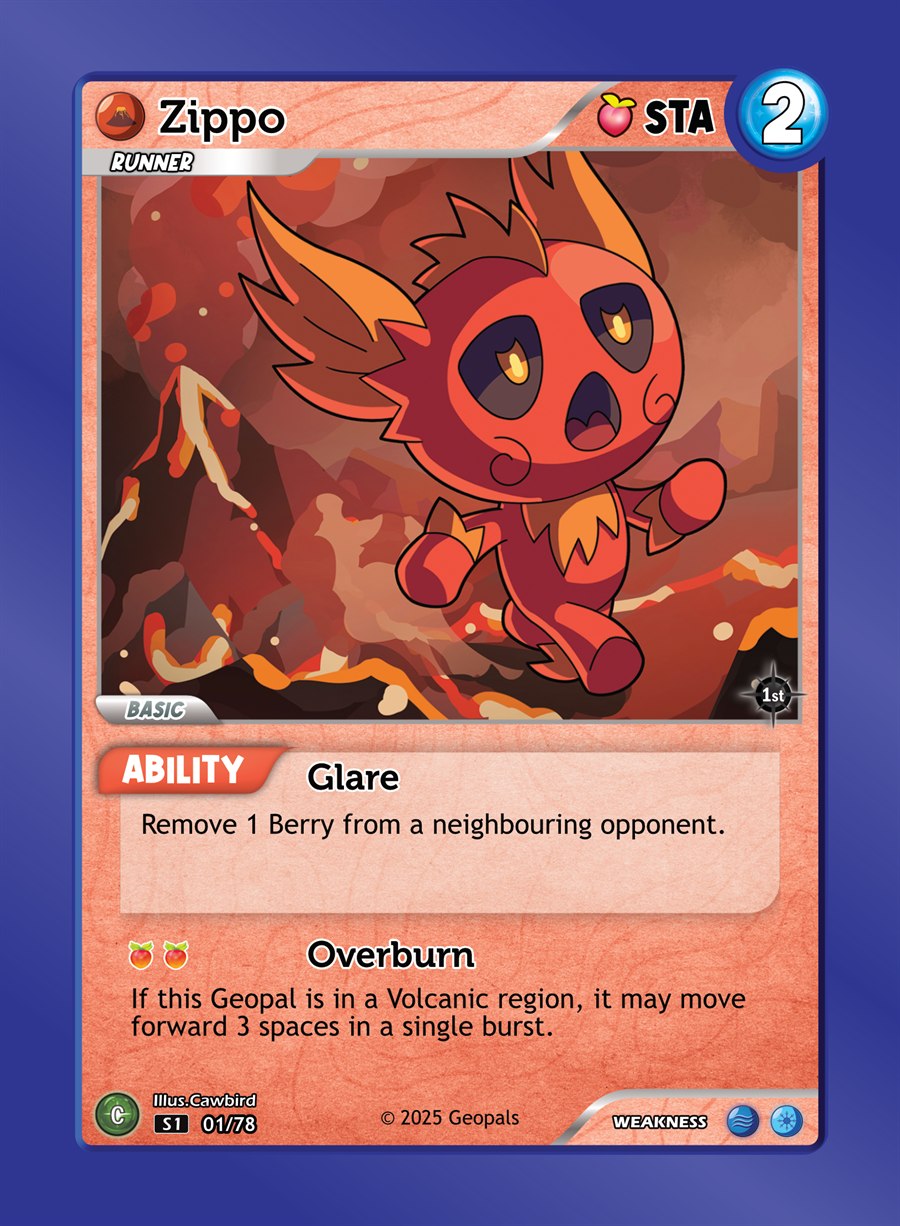
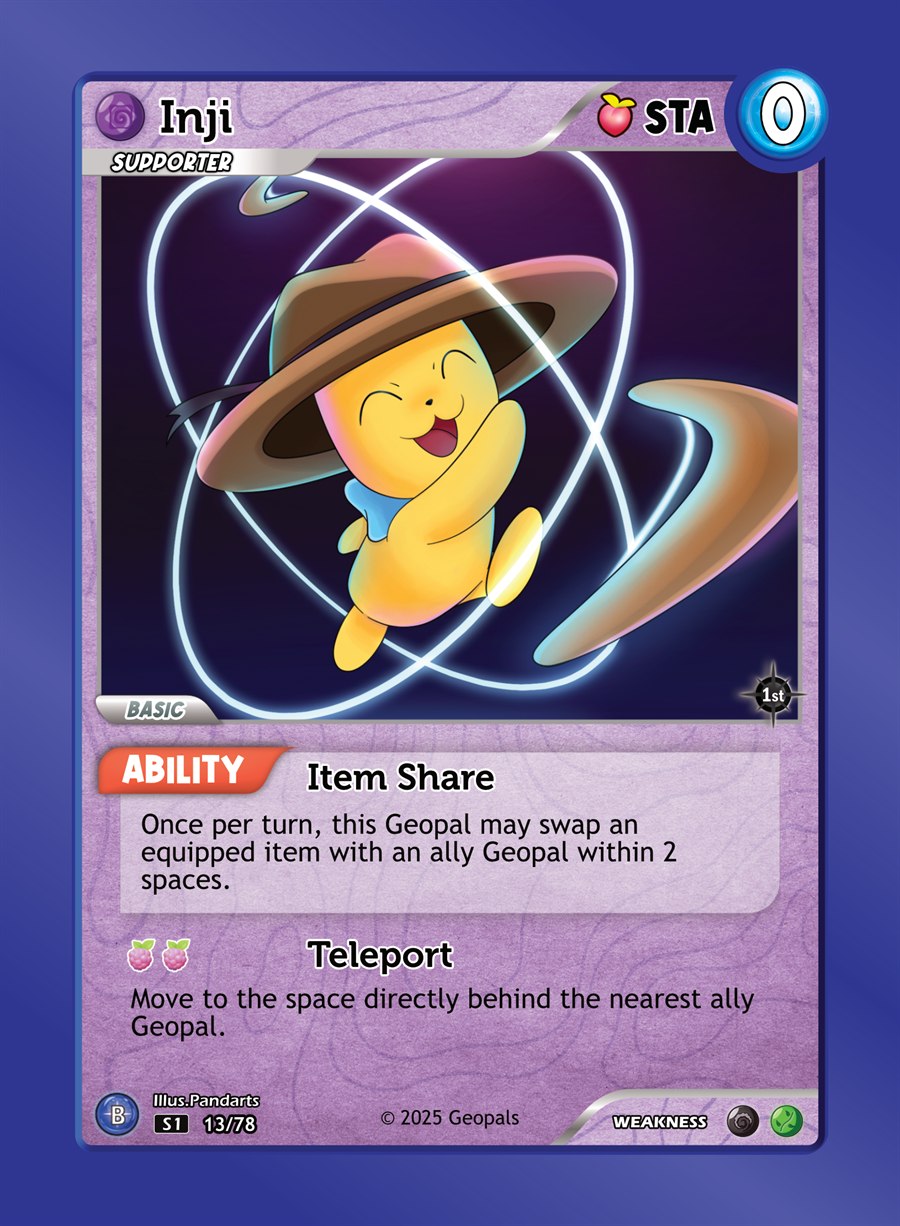
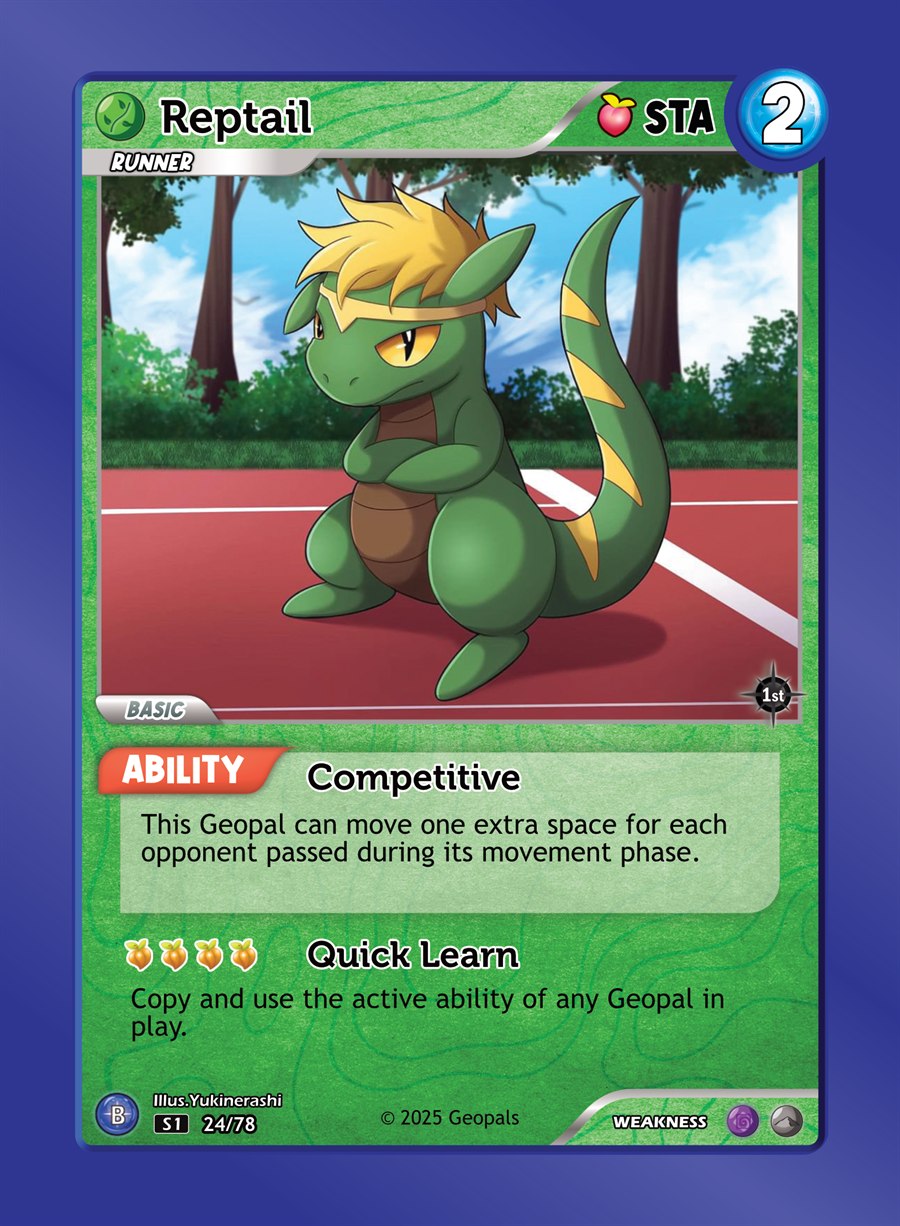
Zippo and Inji are out on the Volcanic card. Reptail has reached the Ocean card. The red marker is a tile with a Trap set on it, and the two face-down cards in the Trap Zone are those Traps.
What is each part of the mat for?
What each part of the mat is for
- Trap Zone The long strip along the top. Trap cards go here face down, and each one is assigned to a tile out on the map. Your opponent can see which tile a Trap is on, but not what it does.
- Play Zone Your active Geopals go here, with their Stamina cards and Items stacked on them. You can have up to three Geopals in play at a time.
- Discard Cards you have used or thrown away.
- Deck Your draw pile. If it runs out, shuffle your discard pile and it becomes your deck again.
- Awakened forms The blank space directly above your Deck and below the Trap Zone. Your Stage 1 and Stage 2 Geopals wait here face up until one of your Geopals awakens. They are never shuffled into your deck.
The map is not on your playmat. Terrain cards are laid on the table in the space between the two players.
What each player needs
Bring with you
- A deck of up to 70 cards. There is no minimum. Around 60 is a good size.
- One of each Geopal, any number of Stamina cards, and up to two of every other card.
- Tokens for your Geopals.
- A Terrain deck of at least six cards, with only one card of each region.
Build together
- Each player lays two Terrain cards, so the map is four cards long.
- Both players start at the same end.
- The far end of the map is the finish.
Which Geopals come out of your deck
Before you start, every Stage 1 and Stage 2 Geopal comes out of your deck. Look at the bottom left corner of the artwork.
If a Geopal card has that little picture in the corner, it is an awakened form. It goes face up above your deck, and it is never shuffled in.
Setting up, step by step
- Take your awakened forms out of your deck. Every Stage 1 and Stage 2 Geopal comes out and sits face up above where your deck will go. They are never shuffled in.
- Choose the Geopal you want to start with. Search your deck for it and put it in your Play Zone.
- Put that Geopal's token on the map, at your starting end.
- Shuffle your deck and put it down as your draw pile.
- Shuffle your Terrain deck separately. It is a second, smaller deck and it never mixes with your playing deck.
- Take turns laying Terrain cards into the space between you. Two cards each, four in total. They join end to end and become the map.
- Draw six cards into your hand.
- Play scissors, paper, rock to decide who goes first.
Step 3 of 5
Your turn, step by step
Every turn is one loop: Act, then Move, then Draw. Moving is not a separate phase of the game, it is the part that finishes your turn. Click through a real turn below and watch it happen.
Trap set here
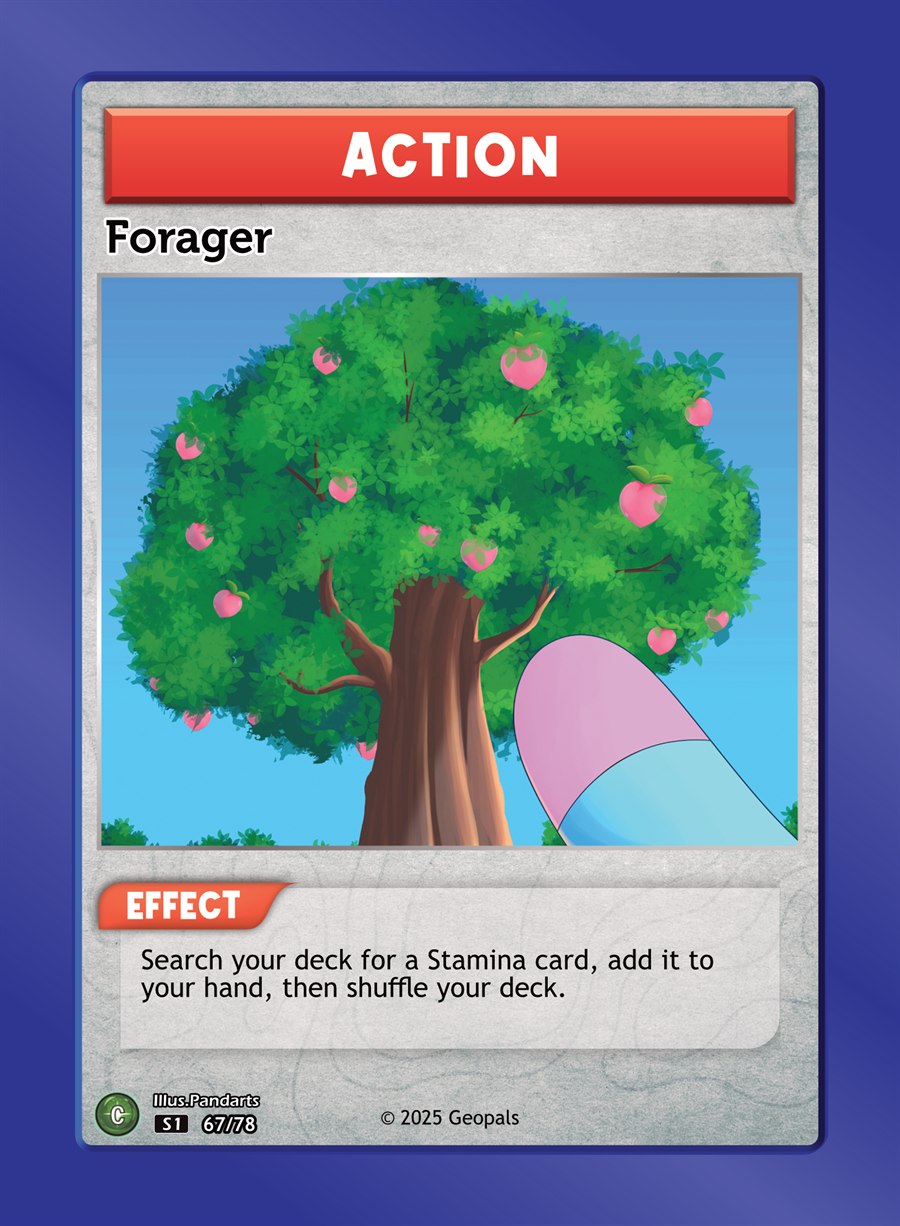
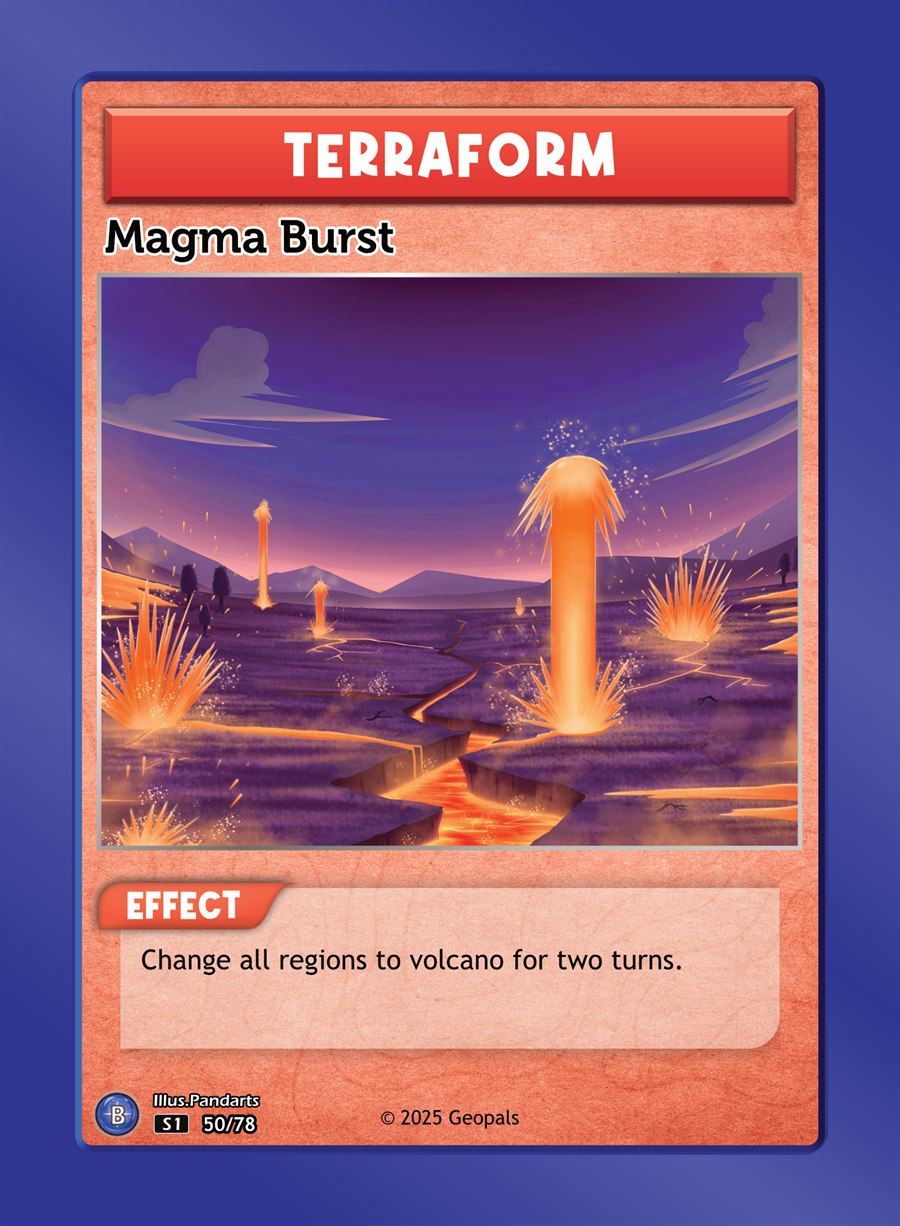
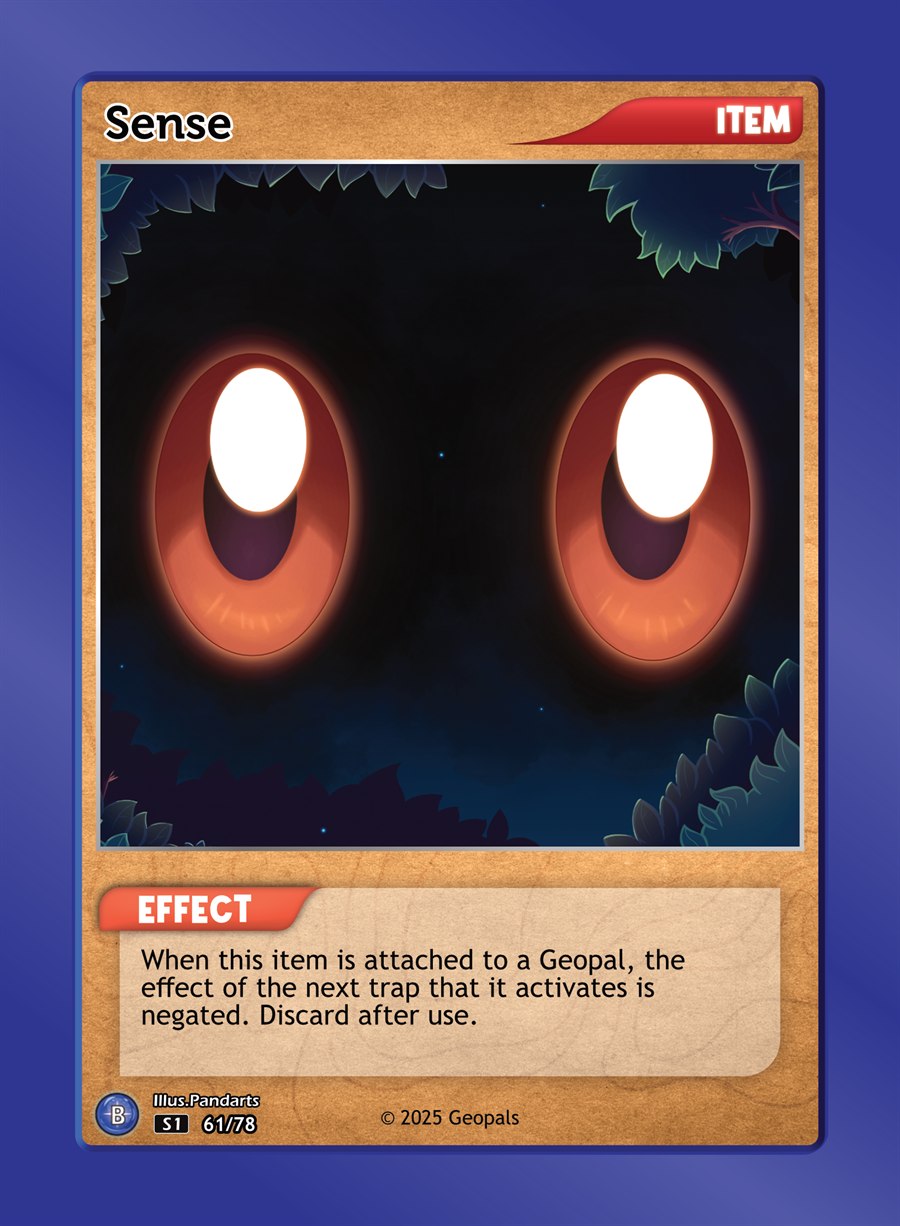
This is your hand at the start of your turn.
What can I do during the action phase?
- You can play as many cards from your hand as you like, or you can discard as many cards as you like. You cannot do both in the same turn.
- You can use the abilities of your Geopals. Each ability can only be used once per turn.
- You can do these things in any order.
What happens if I run out of cards?
Shuffle your discard pile. It becomes your deck again, so you never run out for good.
How do Traps work?
Put a Trap face down in your Trap Zone and choose a tile for it.
Your opponent can see which tile the Trap is on. They cannot see what it does, because the card stays face down until it goes off.
The Trap goes off the moment an opposing Geopal steps onto that tile. It does not have to be the tile they were going to finish on. If they walk onto it halfway through a move, the Trap still goes off.
That Geopal stops on the tile, the Trap is turned face up, and its effect happens. Any movement it had left is lost.
Here it is happening. The Geopal is on its way to the fifth tile, but it never gets there.
 Stopped
The Trap was set on the third tile. The Geopal steps on it, stops there, and the card turns face up.
You can only set one Trap at a time per Terrain card. With a four card map, that is four Traps at most. A Trap cannot be picked up, discarded or played over, so the slot only frees up when the Trap goes off.
Step 4 of 5
How far your Geopals go
You have seen a Geopal move in the walkthrough. This step is about the thing that decides how far it goes. It is the part new players most often get wrong, so it is worth reading carefully.
Stamina cards are your movement. A Geopal moves one tile for every Stamina card attached to it. Max Stamina is the number printed on the card, and it is the most Stamina cards that Geopal can ever use.
You must move the full distance. A Geopal with three Stamina cards and a Max Stamina of 3 must move exactly three tiles. You cannot choose to move it one or two tiles instead.
You do choose which Geopals move. Any number of them, from none to all. Moving one does not oblige you to move the others, even if they could. The choice is whether a Geopal moves, never how far.
See it on a real card
1
2
- Max Stamina 2 This is the number printed in the corner. It
is the most Stamina cards Zippo can ever use, so Zippo will never
move more than two tiles in a movement phase.
It is not how far Zippo moves today. That depends on how many Stamina cards you have actually attached to it. - Overburn costs 2 Heat Berries The berries printed next to
an active ability are its price. Zippo is Volcanic, so it pays
with Heat Berries.
Overburn reads: if this Geopal is in a Volcanic region, it may move forward 3 spaces in a single burst. That is on top of the normal movement phase, so used first it can carry Zippo five tiles in one turn.
Put those two together and you get the whole rule.
A third Heat Berry would not help. Zippo can never use more than two, because that is its Max Stamina.
Stamina cards stay where you put them. Once a Stamina card is attached to a Geopal, you cannot take it off, and you cannot move it to another Geopal. The only exceptions are when a Geopal ability or an Action card specifically lets you.
Must move exactly 2 tiles.
Must move exactly 3 tiles.
Cannot move at all.
A Geopal with nothing attached to it cannot move. Playing Stamina cards onto it during your action phase is what gets it going.
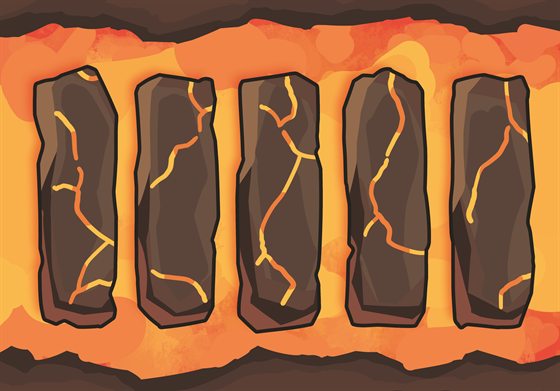
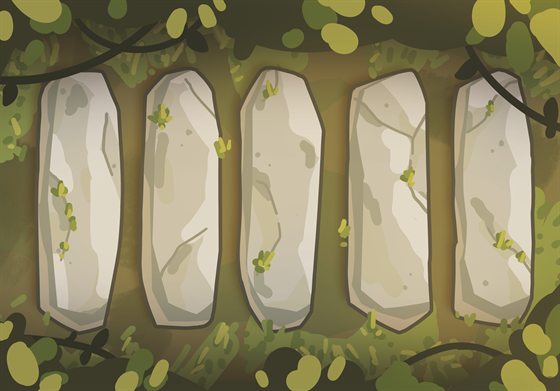
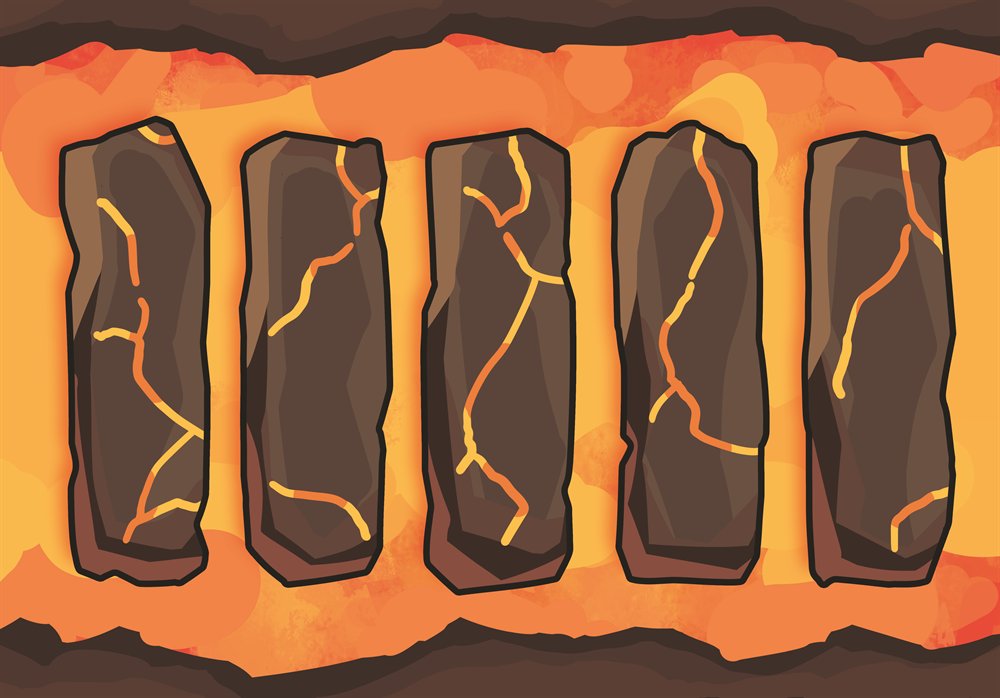
Each stone slab is one tile, and one tile is one space. This Volcanic card is five of them.
An active ability spends the Stamina cards that pay for it. The berries printed beside the ability are a real cost, not a minimum you have to reach. Pay them and they go to your discard pile.
This is why a Geopal often carries more Stamina cards than its Max Stamina. Max Stamina limits how many it may use to move. It does not limit how many it may hold. Carry extra and you can pay for an ability and still take your movement phase.
Awakening costs three Stamina cards, so stocking a Geopal up is also how a Geopal with a low Max Stamina awakens.
The four Stamina cards
There are four Stamina cards, and each one serves two regions.
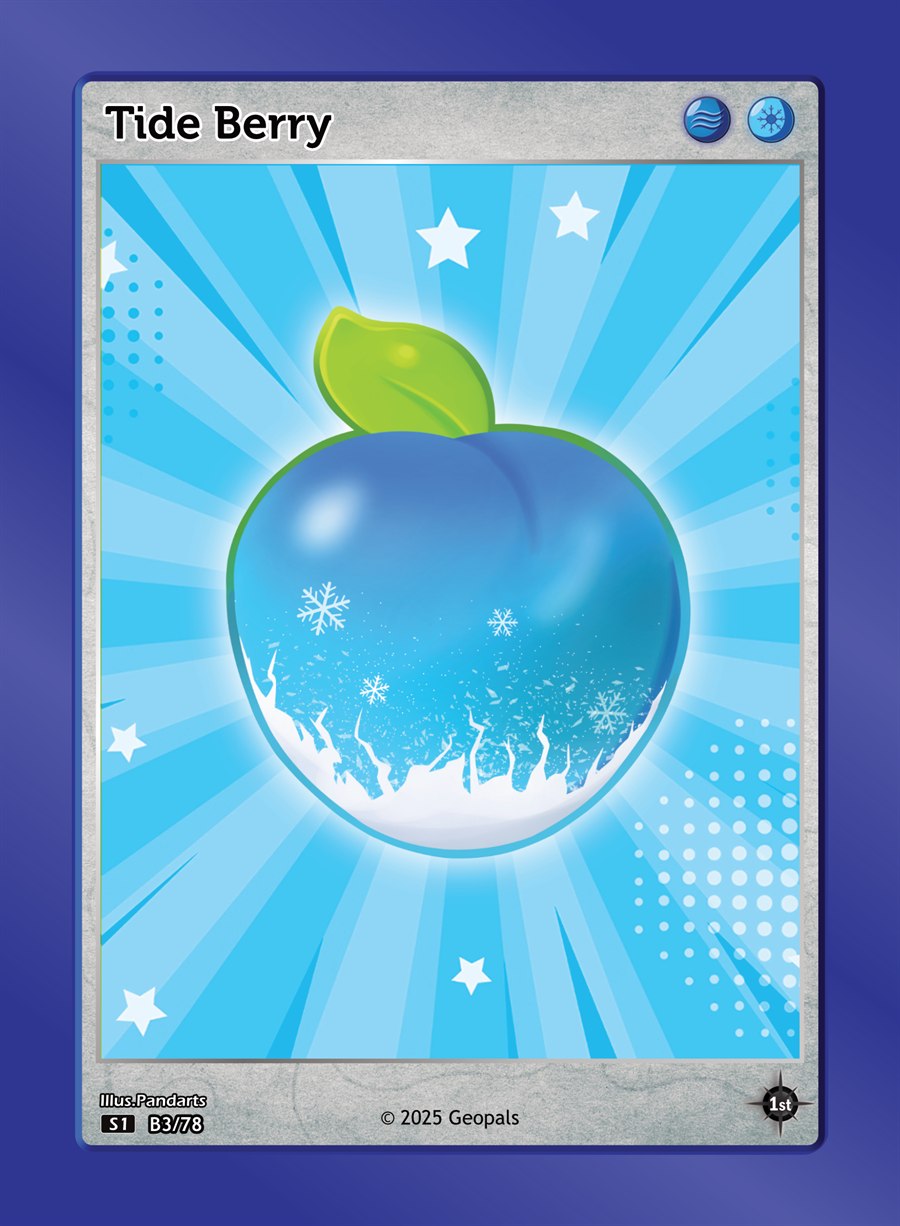
Any Stamina card will do
For ordinary movement, and for awakening a Geopal, the type does not matter. You can use any Stamina card.
The type has to match
For an active ability, it does matter. A Geopal can only pay using the Stamina card that serves its own region. A Mystic Geopal has to pay with Sky Berries.
What if I run out of Stamina cards?
Running out of Stamina cards in your hand
Stamina cards are the thing you will run short of, because every tile of movement costs one.
Some Action cards and some Geopal abilities let you search your deck for Stamina cards and put them into your hand. They are worth keeping in your deck, because a Geopal with nothing attached to it cannot move at all.
Regions change how far you get
Every Geopal belongs to a region, and so does every Terrain card. Matching them up is the heart of the game. Here is one Geopal meeting three kinds of ground.
Zippo, a Volcanic Runner
Max Stamina 2, so Zippo moves up to two tiles in a movement phase.
 Home: Volcanic
 Weak: Ocean
 Weak: Ice
Every Geopal card lists the regions it is weak in along the bottom right, next to the word WEAKNESS.
Zippo is stuck on that first Ocean tile until something changes the ground or carries it through. It does not stop short of the card, and it does not sit between cards. It always ends up on the first tile of the region it cannot cross.
Which regions is each one weak in?
Every region is weak in two others. This is the full chart.
| Region | Weak in | |
|---|---|---|
 Desert |
Ocean |
Ice |
 Forest |
 Mystic |
 Mountain |
| Ice |
Volcanic |
Desert |
| Mountain |
Forest |
 Shadow |
| Mystic |
Shadow |
Forest |
| Ocean |
Volcanic |
Desert |
| Shadow |
Mystic |
Mountain |
| Volcanic |
Ocean |
Ice |
You do not have to memorise this. Each Geopal card prints its own two weaknesses, and each Terrain card prints the regions that are weak against it.
Where Geopals can stand
Any number of Geopals can share a tile, and a Geopal can move straight past another one. Nobody blocks anybody unless a card says so.
Neighbouring means one space behind, the same space, or one space ahead. It is checked before your movement phase starts, so you cannot move into position and use the benefit in the same phase.
A Geopal never moves backwards on its own. Only another Geopal’s ability or an Action card can send it back, and that is also how you drag one off a Trap or out of ground it is stuck in.
Getting a stuck Geopal moving again
This happens often, and there are three ways out.
Play a Terraform card
It turns every Terrain card on the map into one region for two turns. The ground your Geopal could not cross becomes ground it can.
Get pulled through
Some Items connect your Geopal to a neighbouring ally. The ally moves and pulls your Geopal along with it.
Use a Geopal ability
Some Geopals let their allies cross ground those allies could not cross alone. Having one on the field can be the difference between moving and standing still.
Which Geopals help their allies through?
These are three examples, not the full list. Plenty of other Geopals have abilities that open up ground, and every Chaser does it for its own region.
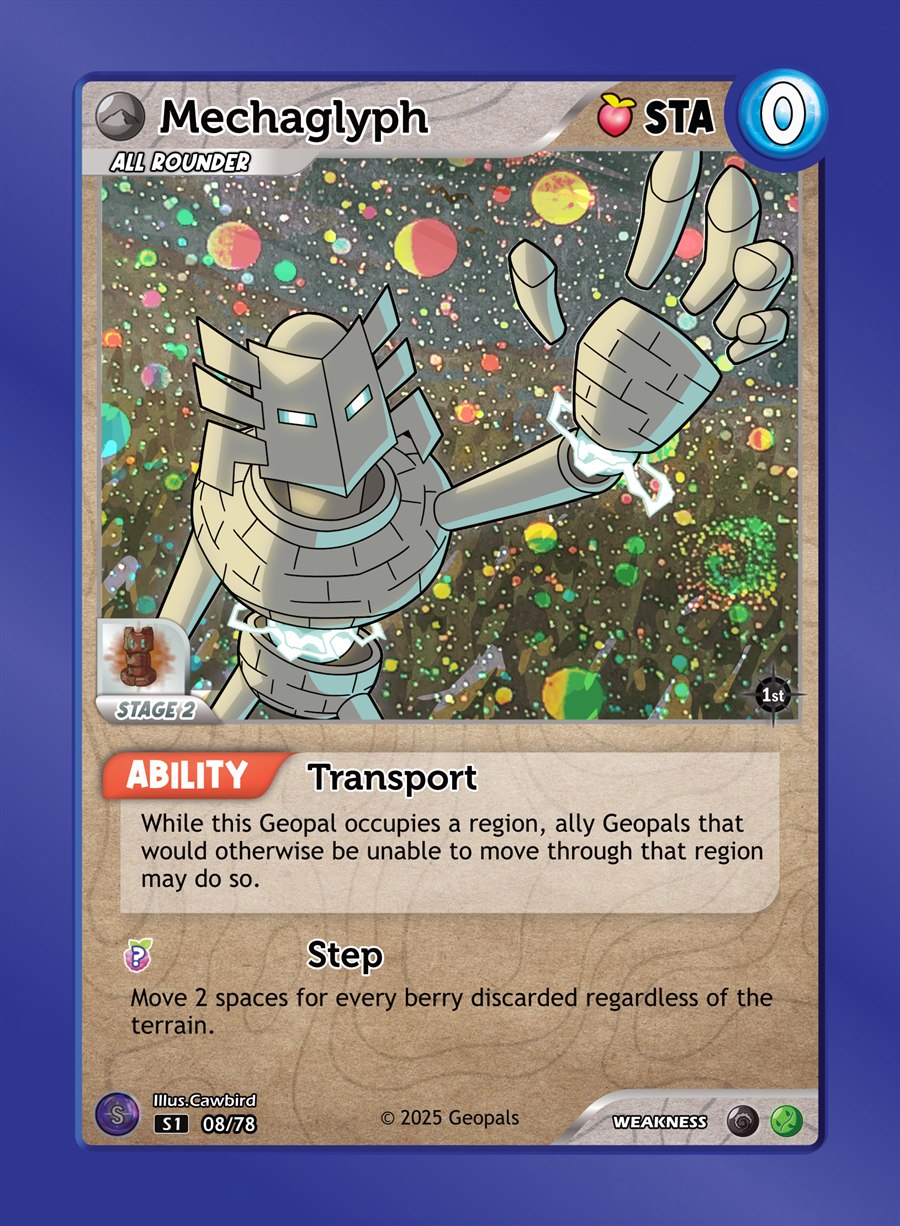
Mechaglyph
Mountain · All Rounder · Max Stamina 0Passive. While this Geopal occupies a region, ally Geopals that would otherwise be unable to move through that region may do so.
Max Stamina 0 means Mechaglyph never moves on its own. It sits in a region and opens it up for everybody else.
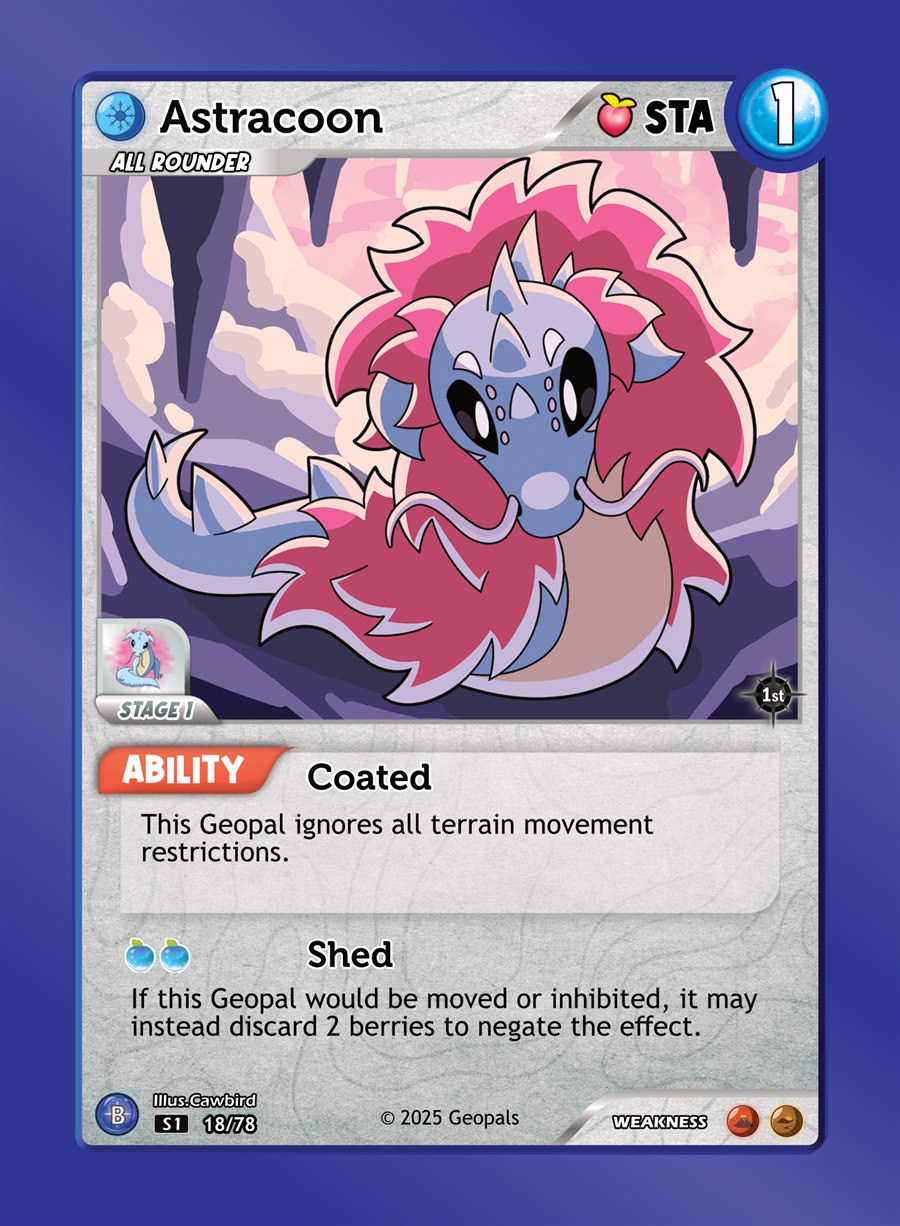
Astracoon
Ice · All Rounder · Max Stamina 1Passive. This Geopal ignores all terrain movement restrictions.
Astracoon goes anywhere. It is slow, but no region can stop it.
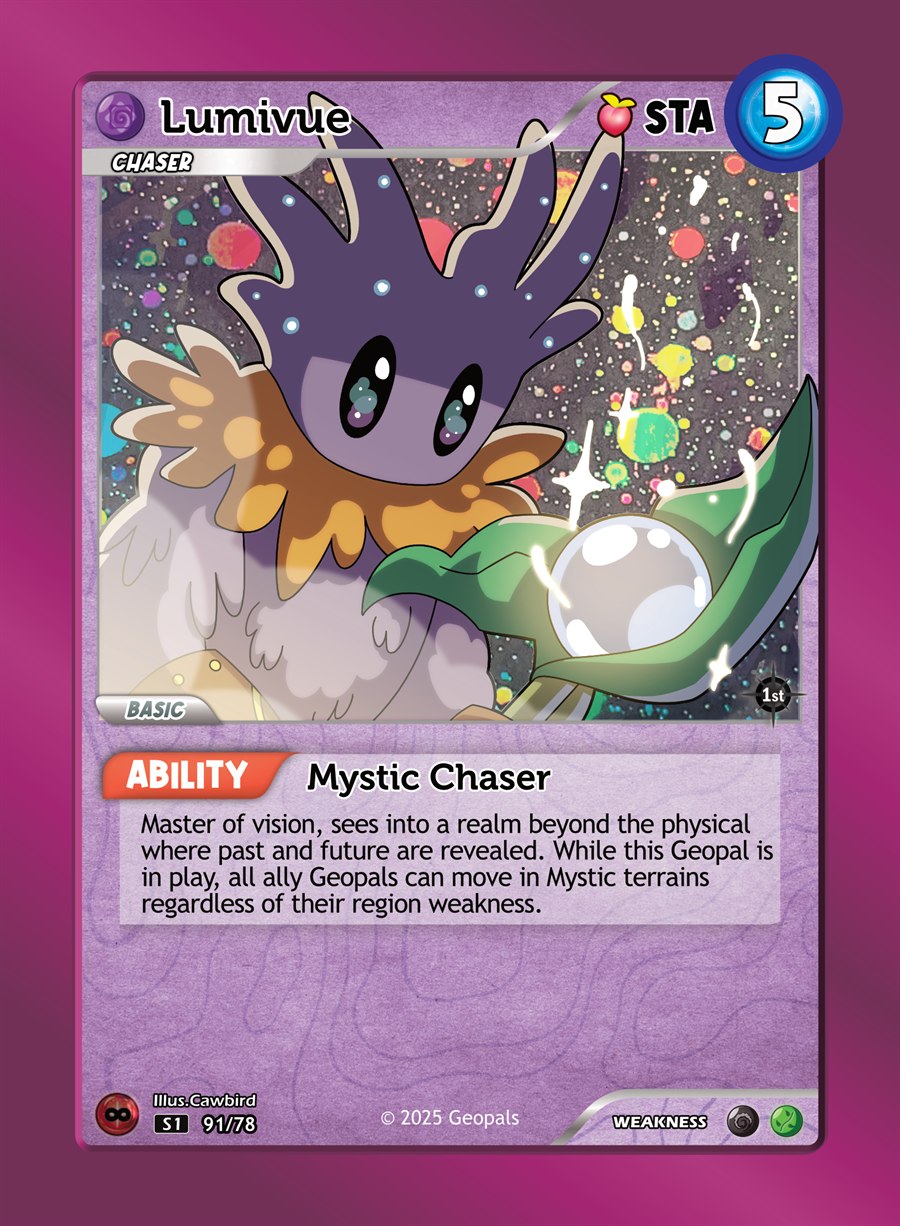
Lumivue
Mystic · Chaser · Max Stamina 5Passive. While this Geopal is in play, all ally Geopals can move in Mystic terrains regardless of their region weakness.
Every Chaser does this for its own region. That is what makes a Chaser a Chaser.
What is each of the four classes for?
The four classes
Every Geopal is one of four classes, printed under its name. The class tells you what that Geopal is for.
Runner
Max Stamina 3 on average, and up to 5Runners cover ground. They have the highest Max Stamina of the ordinary classes, and their abilities are usually about moving further or moving again.
Zippo, Volcanic Runner. Overburn: if this Geopal is in a Volcanic region, it may move forward 3 spaces in a single burst.
Supporter
Max Stamina 1 on average, and never more than 2Supporters are slow. They are not there to win the race themselves. They are there to make the rest of your team faster, and the advantage they give can be bigger than anything one Runner could do alone.
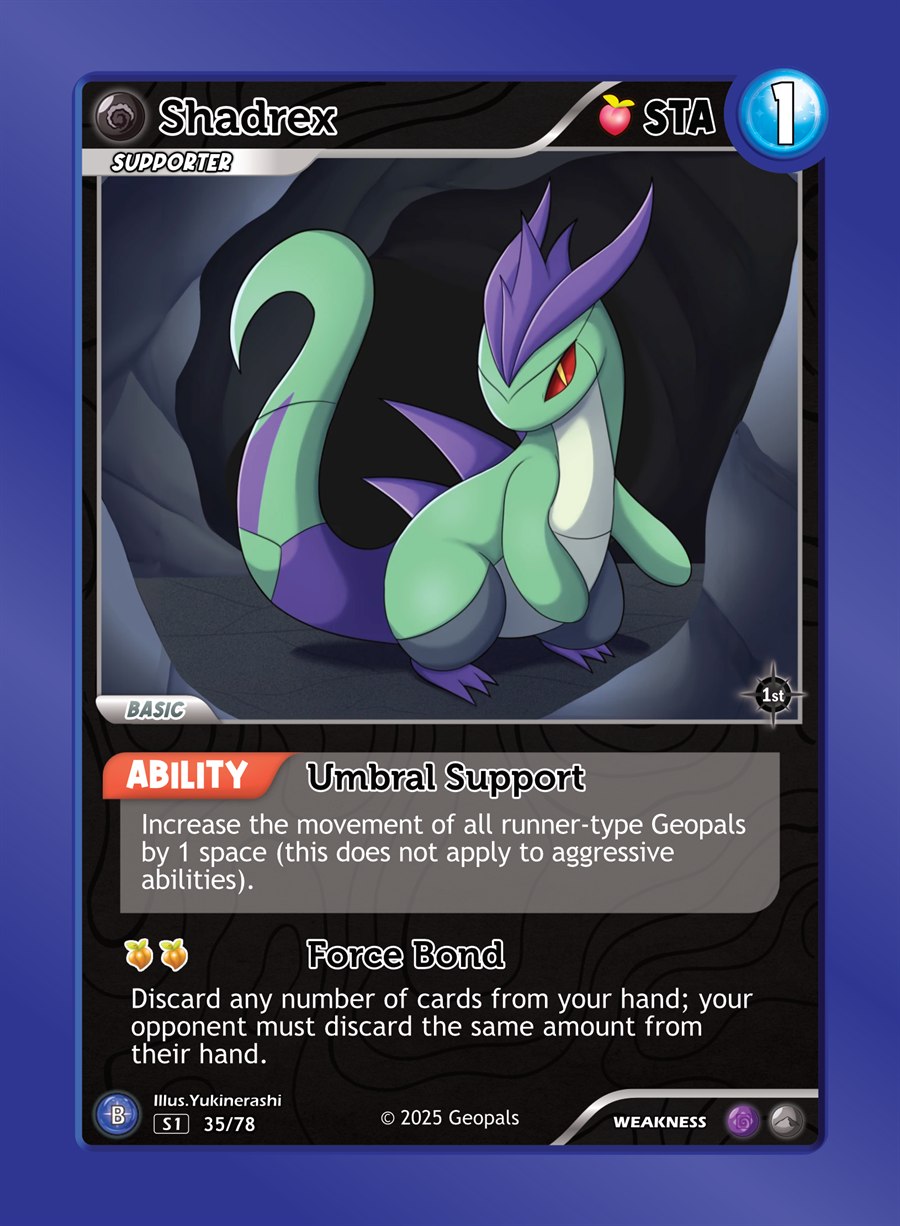
Shadrex, Shadow Supporter. Umbral Support: increase the movement of all Runner Geopals by 1 space.
One card, and every Runner you own moves further for the rest of the game. That is why a slow Geopal can be worth a place in your three.
Supporter, a second example
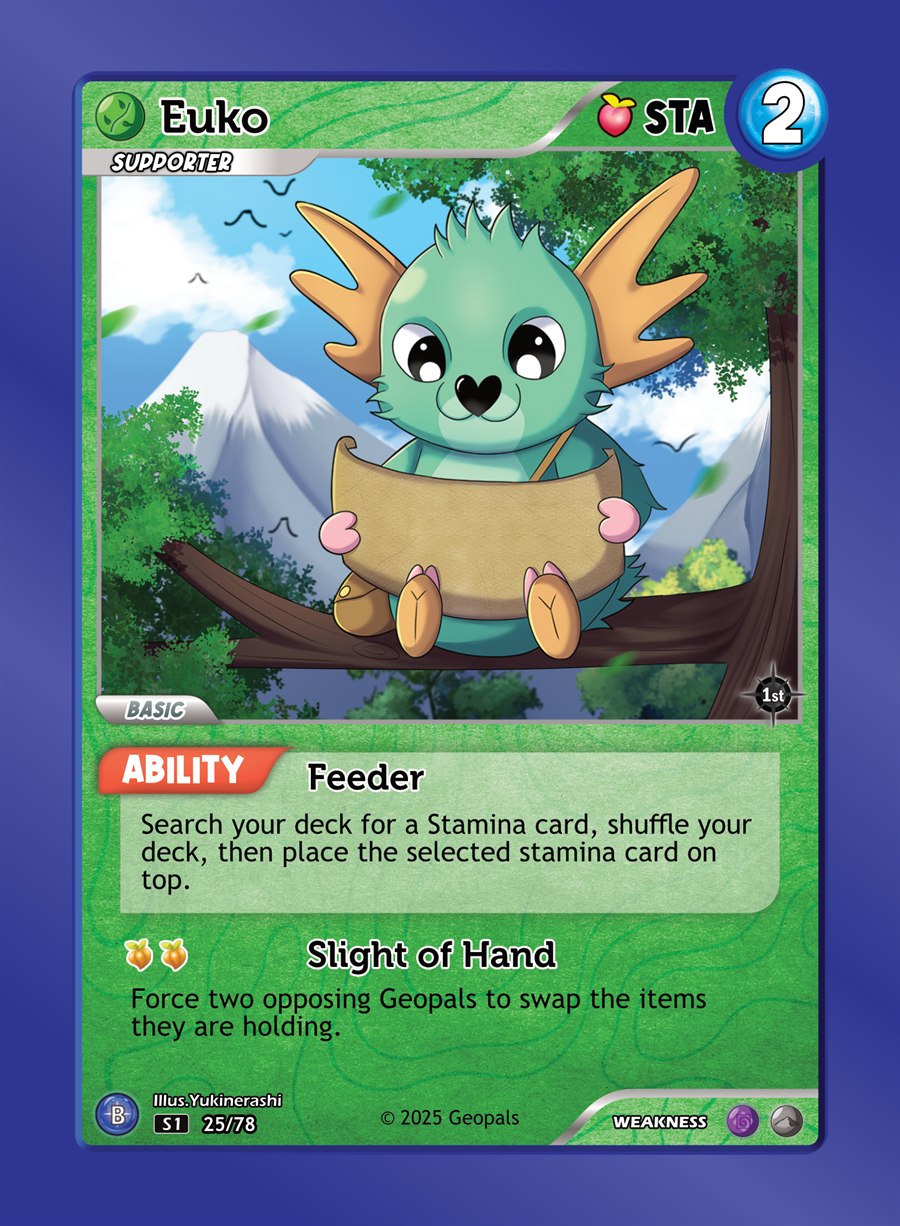
Forest · Max Stamina 2Euko, Forest Supporter. Feeder: search your deck for a Stamina card, shuffle your deck, then put that card on top.
Stamina cards are what you run short of. A Supporter that finds them for you keeps your whole team moving.
All Rounder
Max Stamina 2.2 on averageAll Rounders sit between the two. They move reasonably well and they carry a useful ability, so they are the safe pick when you are not sure what you will face.
Astracoon, Ice All Rounder. This Geopal ignores all terrain movement restrictions.
Chaser
Max Stamina 5, alwaysChasers are the rarest cards in the set and the fastest Geopals in the game. Every Chaser has the same kind of ability: while it is in play, your Geopals can move through its region even if they are weak in it.
Lumivue, Mystic Chaser. While this Geopal is in play, all ally Geopals can move in Mystic terrains regardless of their region weakness.
Picking your three
You can have three Geopals in play at once, so think about what they do together rather than picking the three fastest.
Two Runners and one Supporter is a common shape. The Supporter never wins the race, but it makes both Runners quicker for the whole game.
An ability does not beat a weakness. Using an active ability will not carry your Geopal into a region it is weak in, unless the card explicitly says that it does.
Can a Geopal move twice in one turn?
Moving twice in one turn
Some active abilities move your Geopal. You can use one of these and still take your normal movement phase afterwards, so a Geopal can move twice in one turn.
Pay for it with the matching Stamina cards and move. You are still in your action phase, so you can keep playing.
Move again as normal. This is the part that ends your turn.
You have to do it in that order. Moving normally ends your turn straight away, so an active ability saved until afterwards can never be used.
Step 5 of 5
Win the race
You win a game by getting enough of your Geopals to the far end of the map. There is nothing to guess and nothing to turn over at the end.
The last tile is not the end. Your Geopal has to step off the final Terrain card completely, so you need enough movement left to walk clear of the map.
Scroll the map sideways to see the finish.
Count your Stamina before the last run. A Geopal that lands exactly on the final tile has to wait another turn to get off.
Win two games out of three and you win the match.
Game two is harder than it looks. Getting two Geopals across usually means at least one of them is weak against something on the map, so you have to plan a way through rather than simply run.
Between games
A match is best of three, so you will do this twice. Most of the table resets. Two things do not, and that is where people go wrong.
- Your Geopals stay in play. Move their tokens back to the starting end.
- They keep every Stamina card attached to them.
- They keep their equipped Items.
This is the one that surprises people. A Geopal that finished game one loaded up starts game two still loaded up.
- Everything else on the field, including Traps, goes to the discard pile.
- Your discard pile goes back into your deck, and you shuffle it.
- You take back your Terrain cards.
- You build a brand new map, the same way you built the first one. Not the same map again.
The player who did not win the last game goes first.
✓
You are ready to play
That is everything you need for your first game.
Play it free on a computer, no cards neededHow
You know the rules now. The whole set is built in Tabletop Simulator, every card laid out ready to build a deck from.
Download the game file,
put it in Documents\My Games\Tabletop Simulator\Saves,
then open Tabletop Simulator and choose Games, then
Save & Load.
Tabletop Simulator is a paid app on Steam, about A$30. It is not made by us, and the game file is free.