The Rules
This page has all of the rules in one place. If you have not played before, it is easier to start with Learn to Play, which takes you through the game in five short steps.
Quick reference Everything on this page cut down to one sheet you can print and keep beside the board. For the middle of a game, when you know the rule and just need the number.Setting up
The format
Geopals is played by two players. A full match is best of three games and takes about 80 minutes.
If you want a shorter game, agree best of one before you start. That is a normal way to play, not a house rule.
What each player needs
- A deck of up to 70 cards. There is no minimum, but around 60 cards plays well and much below 50 is not recommended.
- Tokens to represent your Geopals on the map.
- A separate Terrain deck of at least six Terrain cards. You can only have one card of each region, so you cannot include two Forest cards.
How many copies of a card you can run
The limit is different for each type of card.
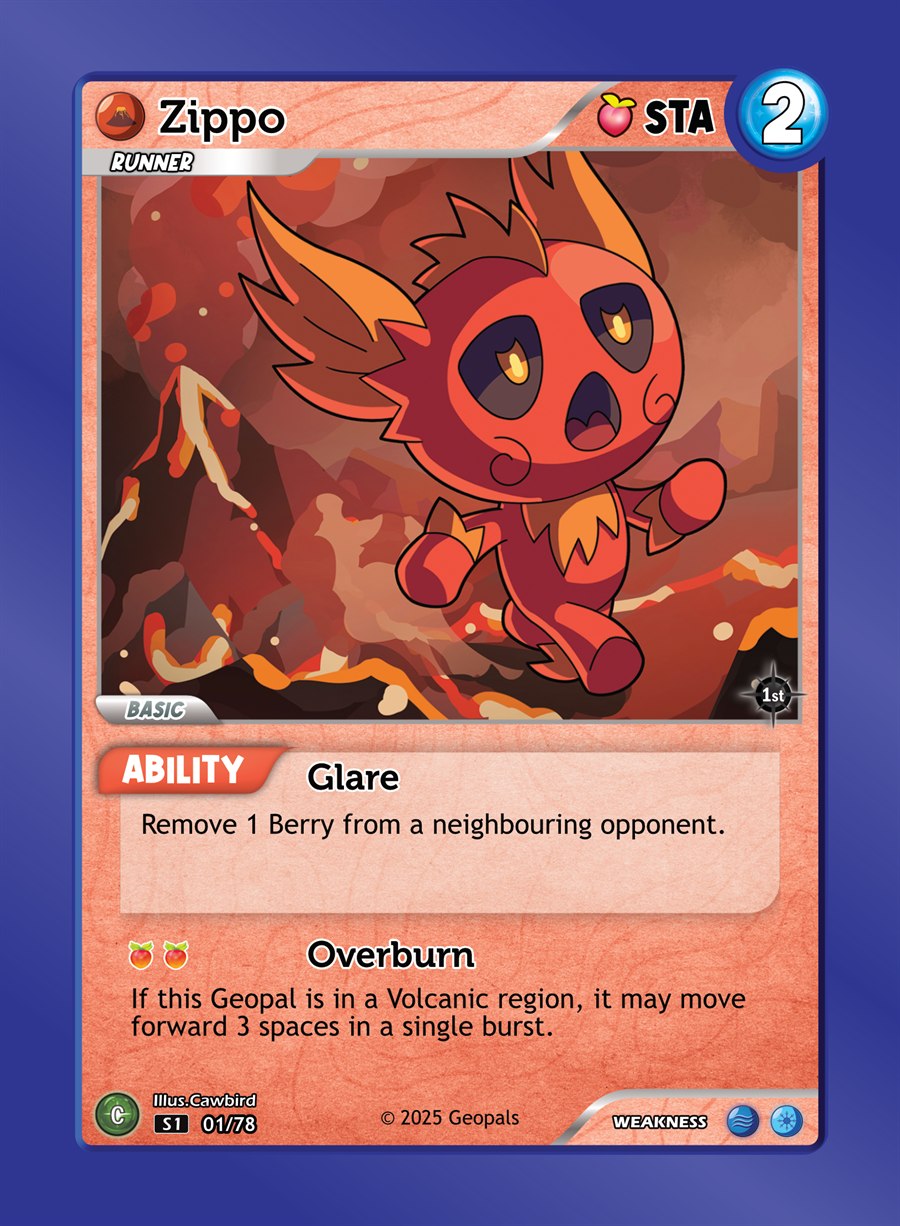
- Geopal cards. One of each. You cannot run two Injis.
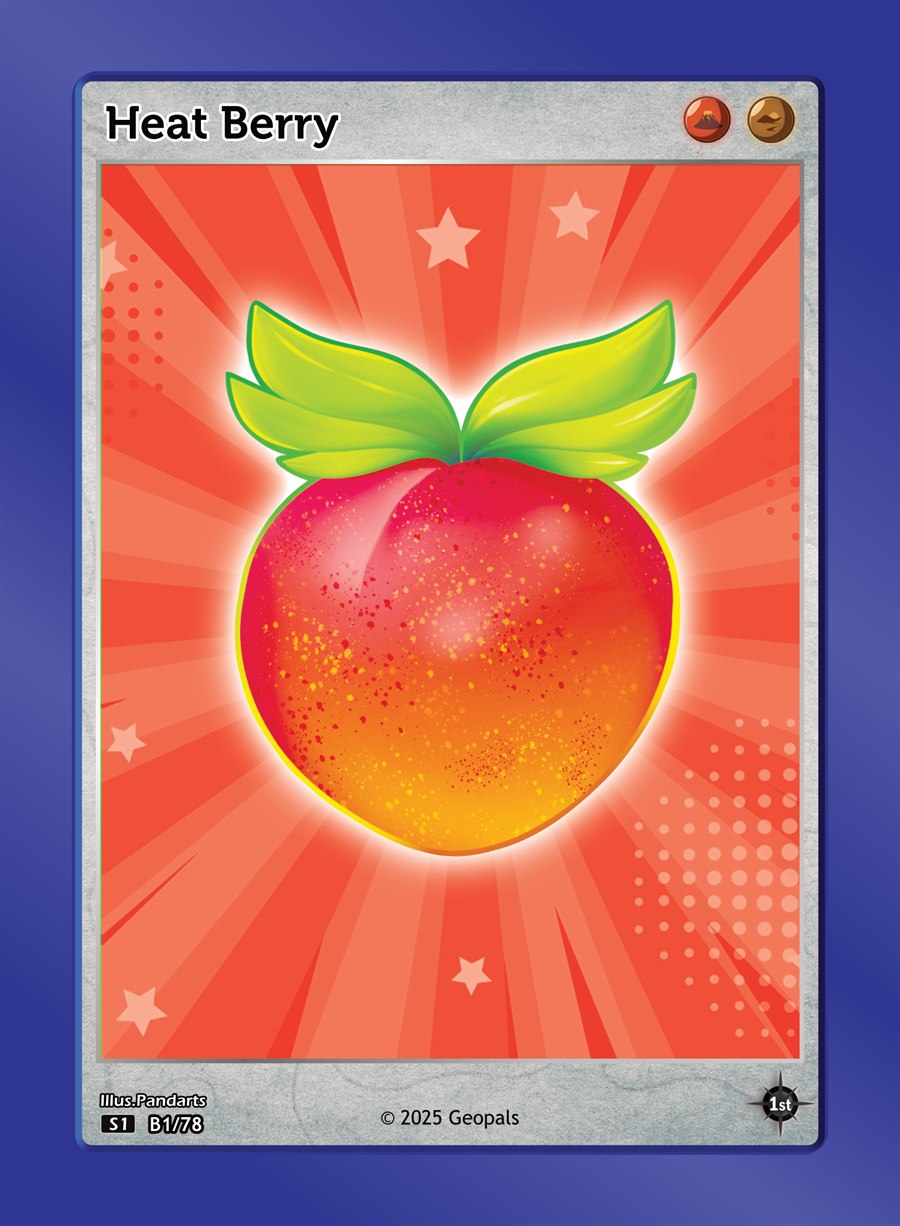
- Stamina cards. As many as you like.
- Action, Item, Terraform and Trap cards. Up to two of each.
Orb cards count as Items, so you can run at most two of them.
These limits are for your playing deck. Your Terrain deck is separate and follows its own rule of one card per region.
How to set up
- Take every awakened Geopal out of your deck. Stage 1 and Stage 2 Geopals are never shuffled into your deck. Put them face up next to where your deck will sit.
- Search your deck for the Geopal you want to start with. Put that card in your Play Zone.
- Put the token for that Geopal on the map, at your starting end.
- Shuffle your deck and put it down as your Deck pile.
- Shuffle your Terrain deck separately. It never mixes with your playing deck.
- Take turns laying Terrain cards into the space between the two players. Each player lays two cards, so the finished map is always four Terrain cards long.
- Draw six cards into your hand.
- Play scissors, paper, rock to decide who goes first.
Where everything goes
Each player has their own playmat in front of them. The map is not on either playmat. Terrain cards are laid on the table between the two players.
- Trap Zone. The long strip along the top of your mat. Trap cards go here face down.
- Play Zone. Your active Geopals, with their Stamina cards and Items stacked on them.
- Deck. Your draw pile.
- Discard. Cards you have used or thrown away.
- Awakened forms. The blank space directly above your Deck and below the Trap Zone. Your Stage 1 and Stage 2 Geopals wait here face up until one of your Geopals awakens.
Taking a turn
Every turn has three phases, and they always happen in this order.
Action
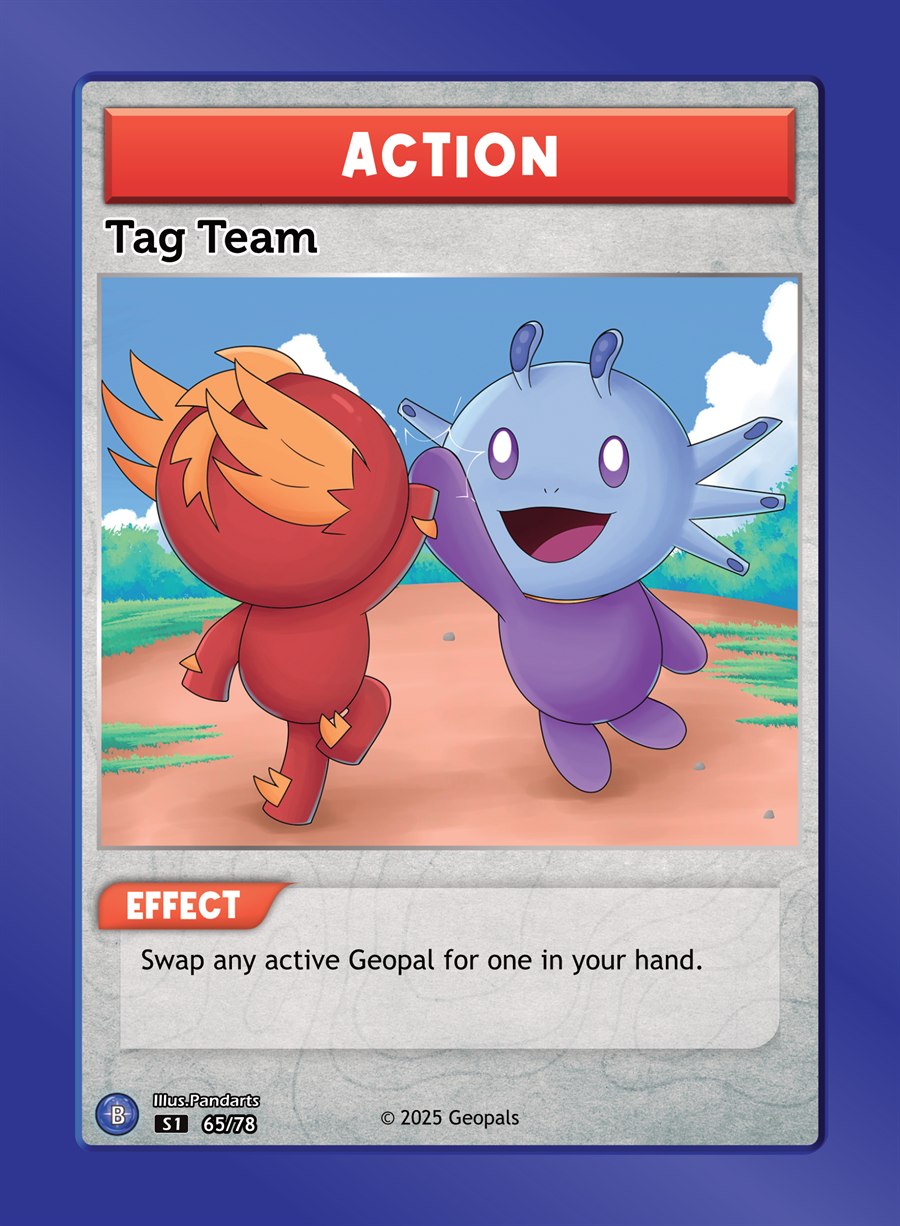
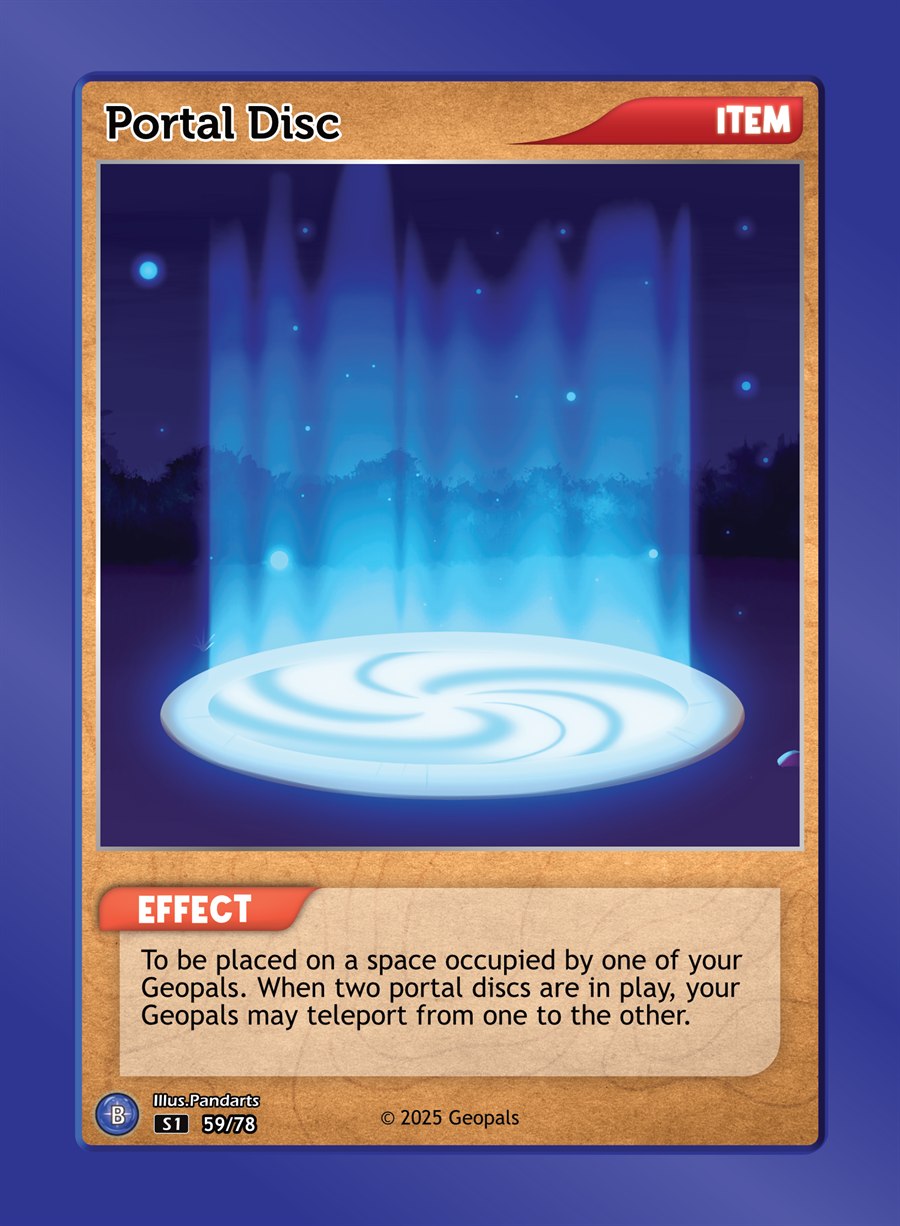
Play cards onto your Geopals, or discard cards. Use abilities. You can do these in any order.
Movement
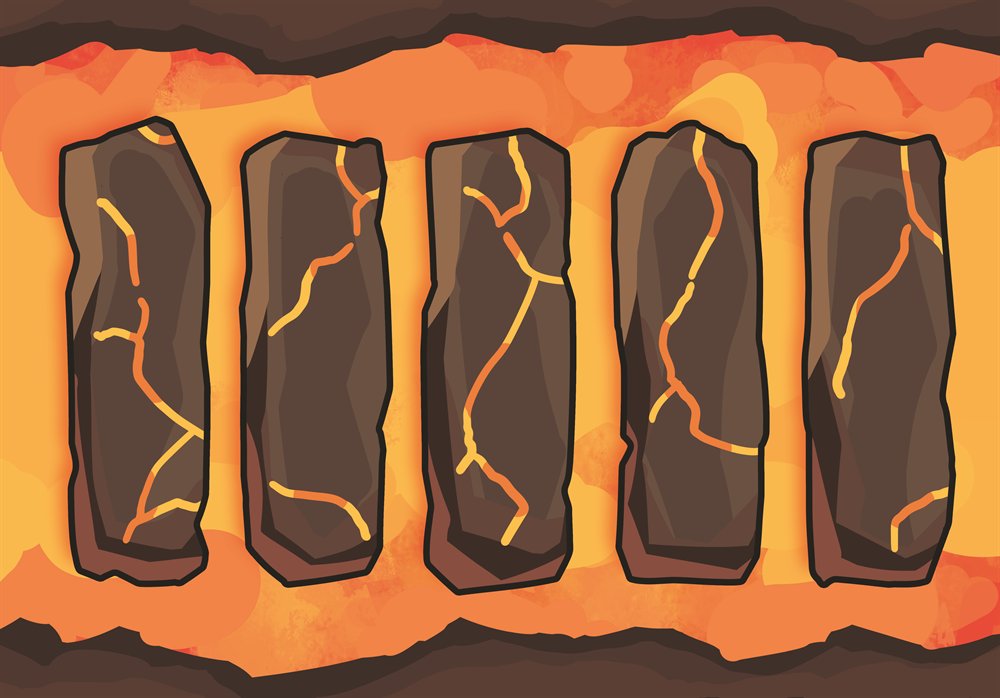

Choose which of your Geopals move. Each one that moves goes the full distance its Stamina cards allow.
End
Draw until you have six cards in your hand. If your deck runs out, shuffle your discard pile and carry on.
1. Action phase
- You can play as many cards from your hand as you like, or you can discard as many cards as you like. You cannot do both in the same turn.
- You can use the abilities of your Geopals. Each ability can only be used once per turn.
- You can do these things in any order.
2. Movement phase
- You choose how many of your Geopals move. Any number, from none of them to all of them. Moving one does not oblige you to move the others, even if they could move.
- If you move a Geopal, it must move the full distance its Stamina cards allow. See Moving for how that distance is worked out.
3. End phase
- Draw cards until you have six cards in your hand.
- If your deck runs out, shuffle your discard pile. It becomes your new deck.
Moving ends your turn. As soon as one of your Geopals moves, you cannot play cards, discard cards, or use abilities. Do everything else first.
Using an active ability and moving in the same turn
Some active abilities move your Geopal. You can use one of these and still take your normal movement phase afterwards, so a Geopal can move twice in one turn.
You have to do it in that order. Use the active ability during your action phase, then move normally. If you move normally first, your turn ends and the ability is wasted.
- Action phase. Use the ability that moves your Geopal.
- Movement phase. Move the same Geopal again, normally.
That Geopal moved twice in one turn.
- Movement phase. You move first.
- Turn over. Moving ended it.
The ability never gets used.
Moving
Stamina cards are your movement
A Geopal moves one tile for every Stamina card attached to it. A Geopal with no Stamina cards cannot move at all.
Max Stamina is the number printed on the Geopal card. It is the most Stamina cards that Geopal can ever use. It is not how far the Geopal moves today.
You must move the full distance. A Geopal with three Stamina cards and a Max Stamina of 3 must move exactly three tiles. You cannot choose to move it one or two tiles instead. You can choose not to move it at all.
Stamina cards stay where you put them
Once a Stamina card is attached to a Geopal, it stays there. You cannot take it off, and you cannot move it to another Geopal.
The only exceptions are a Geopal ability or an Action card that specifically lets you do it.
Carrying more Stamina than you can use
You can put as many Stamina cards on a Geopal as you like. Max Stamina only limits how many spaces it can move.
The extra is there to be spent. Active abilities cost Stamina cards, and awakening costs three, so a Geopal with a Max Stamina of 1 can still do both if you have stocked it up.
A Max Stamina of 0 is deliberate on some cards. That Geopal never moves in its own movement phase. It moves only when something else moves it, and its value is what it does for the rest of your team while it sits still.
Paying for an active ability
An active ability costs Stamina cards. The berries printed beside the ability show how many.
You spend them. The Stamina cards come off the Geopal and go to your discard pile.
A Geopal may hold more Stamina cards than its Max Stamina, because Max Stamina only limits how many it may use to move. Carrying extra is how a Geopal pays for an ability and still takes its movement phase in the same turn.
Where Geopals can stand, and who blocks whom
Any number of Geopals can be on the same tile at once, whether they are yours or your opponent’s. Tiles are not exclusive.
A Geopal can move straight past another Geopal. Standing in the way does not block anybody. The only exception is a card that says otherwise.
Neighbouring means one space behind, the same space, or one space ahead. That is three tiles, counting the Geopal’s own. Whether two Geopals are neighbouring is checked before the movement phase starts, so you cannot move into position and use the benefit in the same movement phase.
Going backwards
A Geopal never moves backwards on its own. Its own movement only ever goes forward.
It can be moved backwards by another Geopal’s ability or by an Action card. That is the only way it happens.
It is also the way out of trouble. Being pulled by an ally or moved by an Action card can drag a Geopal off a Trap tile, or back out of a region it is weak in and stuck at.
Regions
Every Geopal belongs to one of eight regions. Those regions are Mystic, Shadow, Mountain, Forest, Ocean, Volcanic, Ice and Desert. Every Terrain card is one of those regions too.
Ordinary ground
Your Geopal moves one tile for each Stamina card attached to it.
Your own region
If your Geopal finishes its move on a Terrain card of its own region, it moves one extra tile. This applies to your movement phase only, and never to an active ability. It does not stack. It is one extra tile, once.
A region you are weak in
Your Geopal moves onto the first tile of that region and stops there. It cannot go any further in. While it is stuck, it gets no movement phase at all.
Each Terrain card shows the regions that are weak against it in its top right corner. Check there before you move.
Getting a stuck Geopal moving again
There are two common ways to do this.
- Play a Terraform card. It turns every Terrain card on the map into one region for two turns, so ground your Geopal could not cross becomes ground it can. Two turns means one of your turns and one of your opponent’s, not two of yours.
- Use a Geopal ability that says it lets allies through. An ability will not carry a Geopal into a region it is weak in unless the card explicitly says so.
- Use an Item that connects your Geopal to a neighbouring ally. The ally moves and pulls your Geopal along with it.
Winning
A match is best of three games. Win two games and you win the match.
You win a game by getting enough of your Geopals to the far end of the map. There is nothing to guess and nothing to turn over at the end.
The last tile is not the end. Your Geopal has to step off the final Terrain card completely, so you need enough movement left to walk clear of the map.
How many Geopals have to finish
Setting up the next game
- Put everything left on the field, including Traps, into the discard pile.
- Put your discard pile back into your deck and shuffle it.
- Take back your Terrain cards.
- Move your Geopals back to the starting end. They keep their Stamina cards and their Items.
- Build a brand new map the same way you built the first one.
The player who did not win the last game goes first in the next one.
The cards
Your deck can contain six different types of card. Terrain cards are a seventh type, but they are kept in a separate deck and are used to build the map.
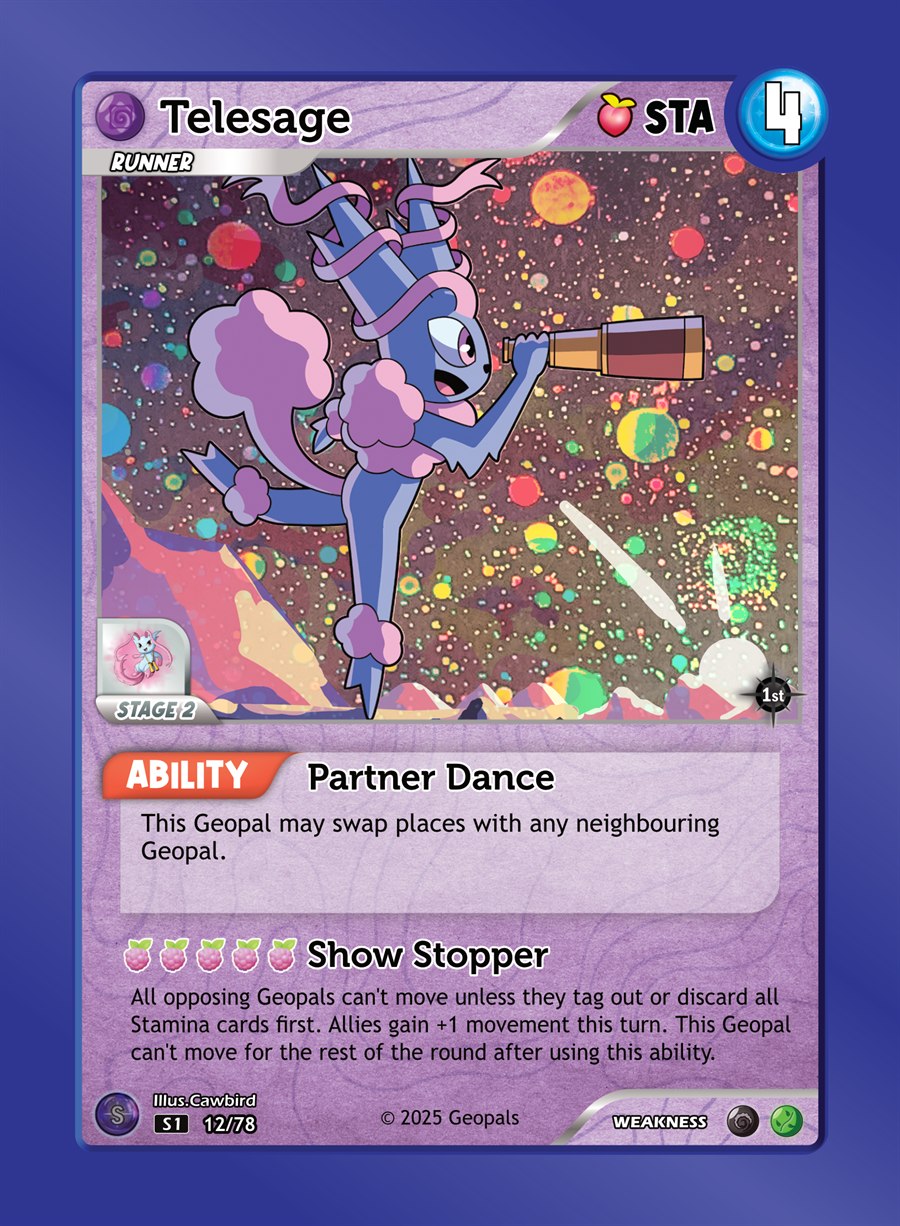
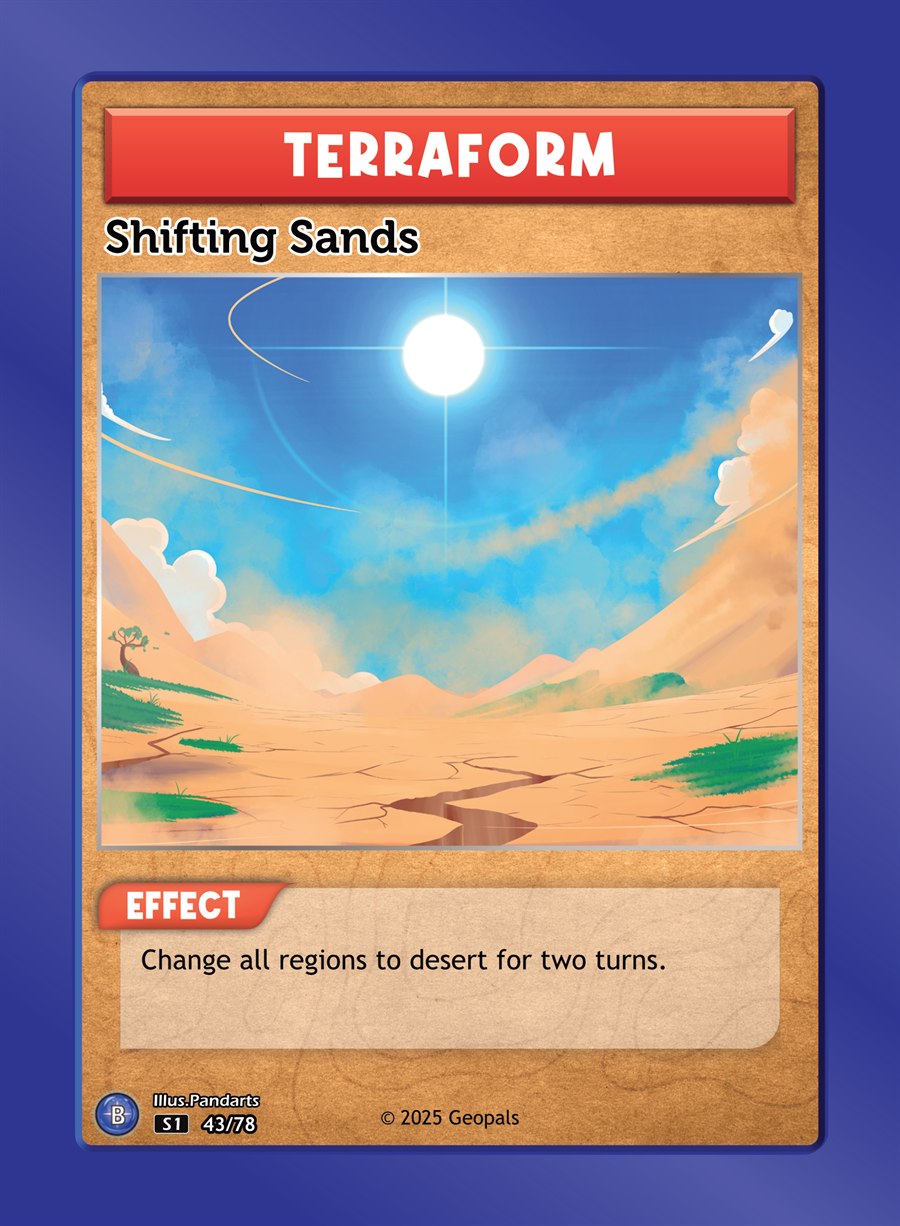
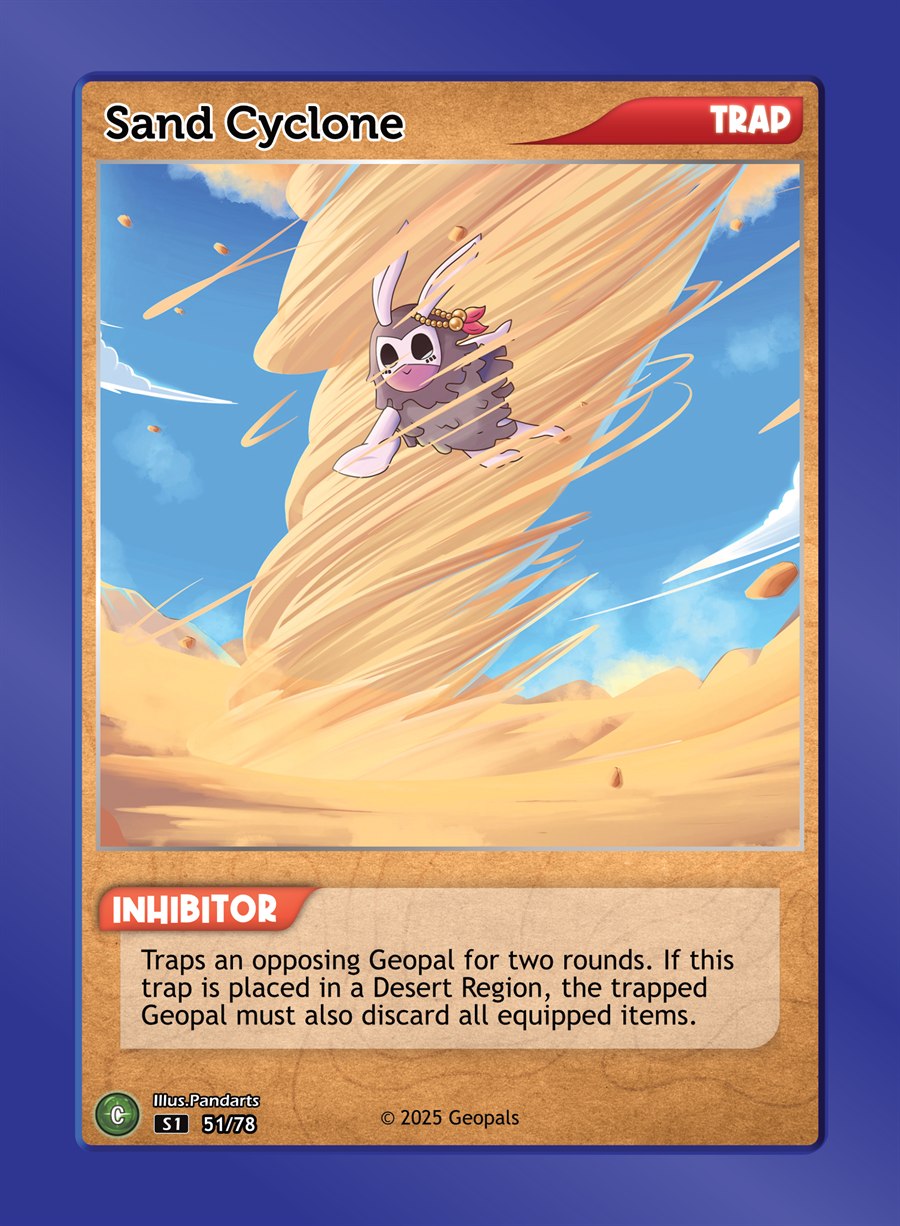
How Traps work
When you set a Trap, point to the tile you are trapping and make sure your opponent agrees where it is. Lining the middle of the card up with that tile helps, but the important part is that you both said it out loud.
Your opponent can see which tile each of your Traps is on. They cannot see what a Trap does, because the card stays face down until it goes off.
Once a Trap is down it stays down. You cannot pick it up, you cannot discard it, and you cannot play another Trap over the top of it. The only thing that clears a Trap is the Trap going off. So a Terrain card with a Trap sitting on it is used up for the rest of the game, which makes where you put one a real decision.
A Trap goes off the moment an opposing Geopal steps onto that tile. It does not have to be the tile they were going to finish on. If they walk onto it halfway through a move, the Trap still goes off.
When a Trap goes off, that Geopal stops on that tile, the Trap is turned face up, and its effect happens. Any movement that Geopal had left is lost.
This is the one thing that overrides the rule about moving your full distance.
Terrain cards
Terrain cards make up the map you race across. Each card is a stretch of one region.
Every Terrain card has a set number of tiles printed on it, between three and five. A tile is one space, and tiles are what movement is counted in.
Each card also shows which regions are weak against it, in the top right corner.
Stamina cards and berry types
There are four Stamina cards, and each one serves two regions.
- Heat Berry serves Volcanic and Desert.
- Sky Berry serves Mystic and Mountain.
- Tide Berry serves Ocean and Ice.
- Earth Berry serves Forest and Shadow.
For ordinary movement, and for awakening a Geopal, any Stamina card will do. The type does not have to match.
For an active ability, the type does matter. A Geopal can only pay for an active ability using the Stamina card that serves its own region. A Mystic Geopal has to pay with Sky Berries.
Reading a Geopal card
- The region symbol shows which region the Geopal belongs to.
- Max Stamina is the most tiles that Geopal can ever move in one movement phase.
- Passive abilities are always available and cost nothing.
- Active abilities cost Stamina cards. The berries printed next to the ability show how many it costs.
- Every Geopal is one of four classes, printed under its name.
- Runner. Built to cover ground. Runners have the highest Max Stamina of the ordinary classes.
- Supporter. Slow, with a Max Stamina of 2 at most. Supporters exist to help the rest of your team rather than to win the race themselves.
- All Rounder. Between the two. Reasonable movement and a useful ability.
- Chaser. The rarest cards, and the fastest. Every Chaser has a Max Stamina of 5, and every Chaser lets your Geopals move through its own region even if they are weak in that region.
Awakening a Geopal
Awakening changes a Geopal into its next form, which is usually stronger. There are two ways to do it, and either one works.
Play an Orb
Play an Orb card onto the Geopal you want to awaken.
Or spend Stamina
Discard three Stamina cards that are already attached to that Geopal.
Take the awakened form from the cards you set aside above your deck and swap it for the card in play. Any Stamina cards and Items stay where they are. Put the old card to one side.
Once a Geopal has awakened, it stays in that form for the rest of the game.
Terms
- Turn
- One player finishing their three phases.
- Round
- Both players finishing a turn each.
- Tile
- One space on a Terrain card. Movement is counted in tiles.
- Neighbour
- Two Geopals standing within one space of each other.
- Ally
- One of your own Geopals.
- Opponent
- Any Geopal belonging to another player.
- Discard
- Putting a card from your hand or from the field into your discard pile.